
Reduce Food Waste in Retail with Better Planning for Grocery Stores


Grocery retailers cut food waste most effectively by replacing reactive ordering with connected planning: demand forecasting tuned to perishables, shared supply chain visibility, cold chain monitoring, automated markdowns, consistent waste tracking, and structured donation programs each close off a specific source of spoilage before it reaches the trash. Together, these levers turn an unavoidable cost of doing business in fresh grocery into a measurable, manageable operating metric.
Table of Contents
For store managers who watch perishable shelves empty into the trash compactor every week, the real question is not whether waste can be reduced but which planning decisions actually move the needle. This article walks through the operational levers that let grocery retailers plan their way to a leaner, more profitable fresh department, from forecasting and inventory systems to cold chain monitoring, markdown timing, and donation programs.
How to reduce food waste in retail with better planning
Reducing food waste in retail with better planning means swapping guesswork and reactive ordering for connected forecasting, inventory, and execution processes that catch surplus before it becomes a write-off. Better planning to minimize food waste works because it targets root causes rather than symptoms: a markdown applied minutes before a product expires can rescue a single case of yogurt, but a forecasting model that orders the right quantity from the start prevents the surplus from ever existing. As outlined in proven demand planning approaches for grocery retailers, planning has shifted from a nice-to-have margin lever into a core operating discipline.
So how can retailers reduce food waste through better planning in practice? The levers covered in this article work together rather than in isolation:
Demand forecasting and inventory systems: matching orders to real sell-through patterns instead of habit or intuition
Supply chain visibility: sharing data across distribution centers, stores, and online fulfillment so surplus does not build up unseen
Cold chain management: protecting product integrity from receiving dock to shelf
Markdown and clearance strategy: moving short-dated stock before it expires without destroying margin
Waste measurement: tracking what is thrown away, where, and why
Donation programs: redirecting unsellable but edible surplus to people who need it
The sections that follow take each lever in turn, covering the specific features, benchmarks, and implementation steps retailers need to put it into practice.
Understanding food waste in grocery stores
Food waste in grocery stores is concentrated in fresh categories, and it is far from a rounding error: it is large enough to materially affect profit margins. Industry data compiled by ReFED found that retailers generated roughly 3.98 million tons of surplus food in a single recent year, nearly 25% of which went to landfill or was incinerated as waste. The loss is not evenly spread across categories: most of this came from produce (32.6%), dairy and eggs (11%), dry goods (11.6%), and fresh meat and seafood (13.6%), and more than half was caused by concerns or confusion over freshness date labels
Category | Share of total retail surplus food |
Produce | 32.6% |
Fresh meat and seafood | 13.6% |
Dairy and eggs | 13.2% |
Dry goods | 12.5% |
Why this matters goes well beyond landfill volume. Analysis of grocery retail economics has described food waste as one of the largest controllable expenses in the business, with the combined effect of product cost, disposal, labor, lost sales, and carrying costs on excess inventory costing retailers up to twice as much as retail profit . Separately, operational research on supermarkets has estimated that food loss and waste costs more than US$1 trillion every year across the global economy, which explains why wastage in retail is treated as a commercial priority and not only a sustainability concern. So why is food waste a problem in retail? It comes down to simple arithmetic: with margins this thin, what percentage of food is wasted by retailers translates almost directly into what percentage of profit disappears with it.
Choosing inventory management systems for grocery stores
Inventory management systems for grocery stores reduce waste by replacing manual, reactive ordering with forecasting tuned specifically to perishables. Many retailers still rely on outdated manual processes in which store managers respond to stockouts by overordering, and this cycle of overcorrection is a documented driver of excess inventory and eventual spoilage. So how do grocery stores forecast demand to reduce waste? The answer starts with day-level, fresh-specific algorithms rather than the weekly or category-level averages used for shelf-stable goods, because fresh demand swings with weekends, weather, and promotions in ways center-store products do not.
Capability | Traditional manual forecasting | AI-driven demand forecasting |
Order basis | Past orders and manager intuition | Historical sales, seasonality, promotions, local demand |
Update frequency | Weekly or category-level | Day-level, item-level |
Response to overstock patterns | Repeated at the same locations | Flagged and corrected through analytics |
Forecasting accuracy is only part of the picture. Retailers evaluating inventory forecasting methods for perishables should also look for adaptive safety stock that adjusts buffer levels automatically, spoilage-based ordering that factors expected losses into order calculations, and exception-based workflows that point staff attention only where intervention is needed. Platforms built around these capabilities have been shown to reduce spoilage substantially while improving availability, and in at least one documented case, an online grocer used automated order proposals to cut manual planning work by several hours per planner each day. A detailed walkthrough of these capabilities, from forecast to fulfillment across the grocery planning process, shows how the pieces connect operationally. When comparing vendors, retailers should also ask how a system handles multi-echelon planning across distribution centers and stores, since store-level forecasting on its own cannot fully resolve network-wide surplus.
Reducing supply chain food waste across the network
Supply chain food waste builds up at the handoffs between distribution centers, stores, and online fulfillment, where no single party can see everything the others hold. Poor coordination between distribution centers and stores creates a disjointed supply chain that fails to optimize inventory across locations, and the growth of curbside pickup and home delivery has added more handling steps where products can be damaged, mis-picked, or left waiting past their optimal freshness window.
Shared visibility closes these gaps by giving every node in the network the same demand and inventory picture. Practices such as cross-docking, more frequent deliveries, and optimizing the minimum shelf life remaining when product leaves the distribution center all shorten the time perishables spend in transit before reaching a shelf. Coordinated multi-echelon replenishment, which aligns store and distribution center orders and optimizes delivery frequency, cuts both transportation costs and the excess inventory that piles up when each location orders independently. Retailers investing in AI-driven inventory and replenishment across the network typically see fewer trucks moving excess stock and fresher product reaching stores, because order accuracy improvements ripple back through the entire chain instead of staying contained to a single location.
Cold chain management and food spoilage explained
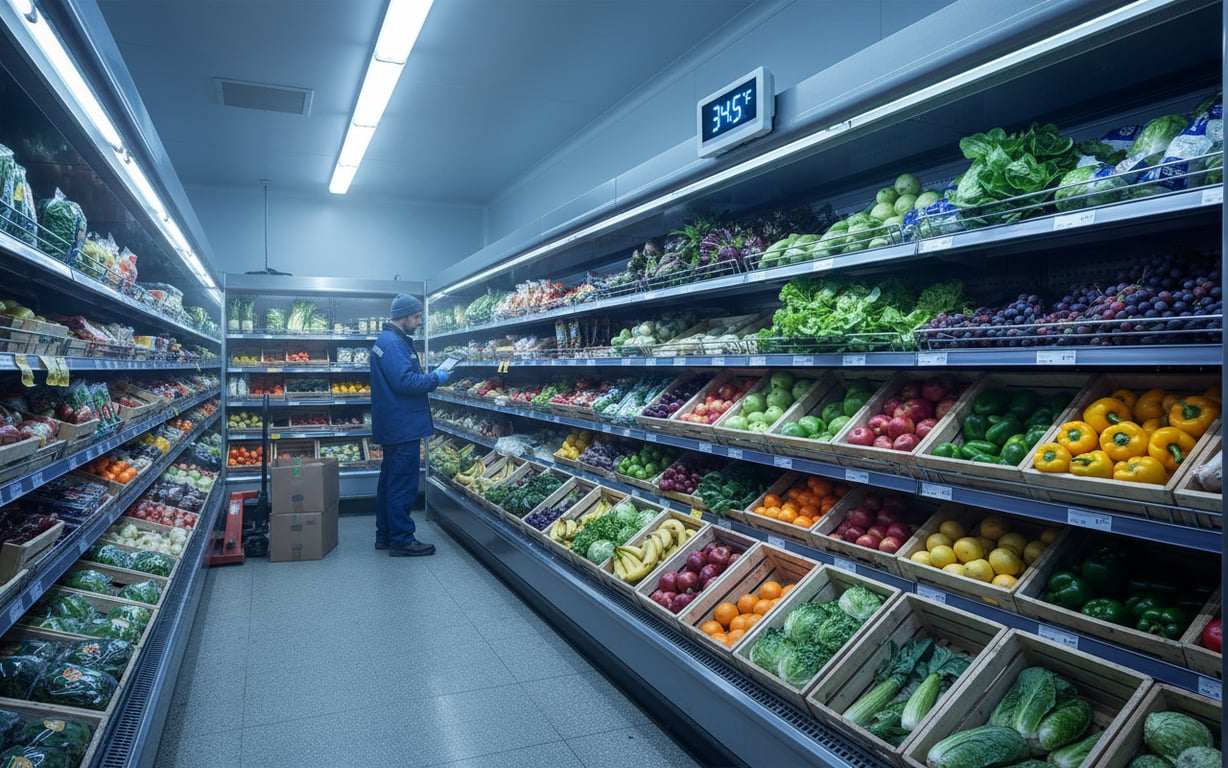
Cold chain management prevents spoilage-driven waste by keeping perishable products within a safe temperature range from receiving through checkout and by catching refrigeration failures before they destroy inventory. Refrigeration is typically the largest single electricity-consuming system in a supermarket, accounting for around 40–60% of electricity use in some estimates. The same equipment that protects product freshness is therefore also one of the store's biggest operating costs, which makes reliable maintenance a dual priority.
Connected IoT sensors extend this protection by monitoring temperatures continuously across refrigerators, freezers, and storage areas, triggering alerts the moment conditions move outside an acceptable range so staff can respond before stock is compromised. Retailers should also audit the full product distribution flow, not just in-store cases, to confirm cold chain integrity holds at every transition point between the truck, the backroom, and the sales floor. Acting on an early temperature alert, rather than discovering spoiled stock during a routine check, is typically the difference between a minor adjustment and a full case write-off.
Markdown strategies for perishable goods that work
Markdown strategies for perishable goods work best when they are timed against actual inventory and demand forecasts instead of being applied on a fixed schedule close to the sell-by date. Research into retail waste practices recommends marking products down only when they would not otherwise sell, and optimizing both the timing and the depth of the discount so retailers recover value without training shoppers to simply wait for the lowest price.
Approach | How it works | Best used for |
Manual markdown | Staff apply discounts based on visual inspection or fixed schedules | Small stores with low SKU complexity |
Automated markdown alerts | Software flags short-dated items and suggests optimal discount timing | Stores with high perishable SKU counts |
Dynamic clearance promotions | Bundling, recipe suggestions, and targeted offers surface slow movers | Surplus that is not yet near expiry but is selling slowly |
Digital pricing tools that identify at-risk products and apply the correct markdown automatically take the guesswork out of this process. Store-level inventory visibility adds another option: when a product moves slowly in one location but sells quickly elsewhere, teams can transfer it instead of discounting it. These execution details depend heavily on connected planning at the store level; retailers struggling with disjointed ordering, labor scheduling, and shelf execution can find a deeper breakdown in how disconnected in-store planning undermines fresh execution. In the end, getting markdown timing right means giving staff clear, system-generated priorities instead of leaving them to rely on memory or spot checks during a busy shift.
Effective food waste measurement and tracking methods
Food waste measurement and tracking methods show retailers whether their planning changes are actually working, rather than leaving them to assume so. A handful of indicators, tracked consistently over time, give a comprehensive view of progress.
Indicator | Formula | What it shows |
Cost of waste as a percentage of sales | (Value of wasted product ÷ total sales) × 100 | Direct financial impact of waste relative to revenue |
Forecast accuracy at day level | 1 − (|Forecast − Actual| ÷ Actual) | Precision of daily demand prediction for fresh items |
Inventory turnover (fresh) | Cost of goods sold ÷ average inventory value | Speed products move through the system |
Retail food waste tracking platforms typically combine these indicators with service-level tracking, which shows whether orders were fulfilled completely and on time, and with an overall waste reduction percentage measured against an established baseline. When waste reduction efforts are working, improvement should show up across all of these metrics together; if only one moves, the underlying process probably needs rethinking. A closely related discipline, fresh department performance management, is covered in more depth in this guide to fresh store operations and measuring performance, which pairs these metrics with store-level execution practices.
Food donation programs for retailers with surplus stock
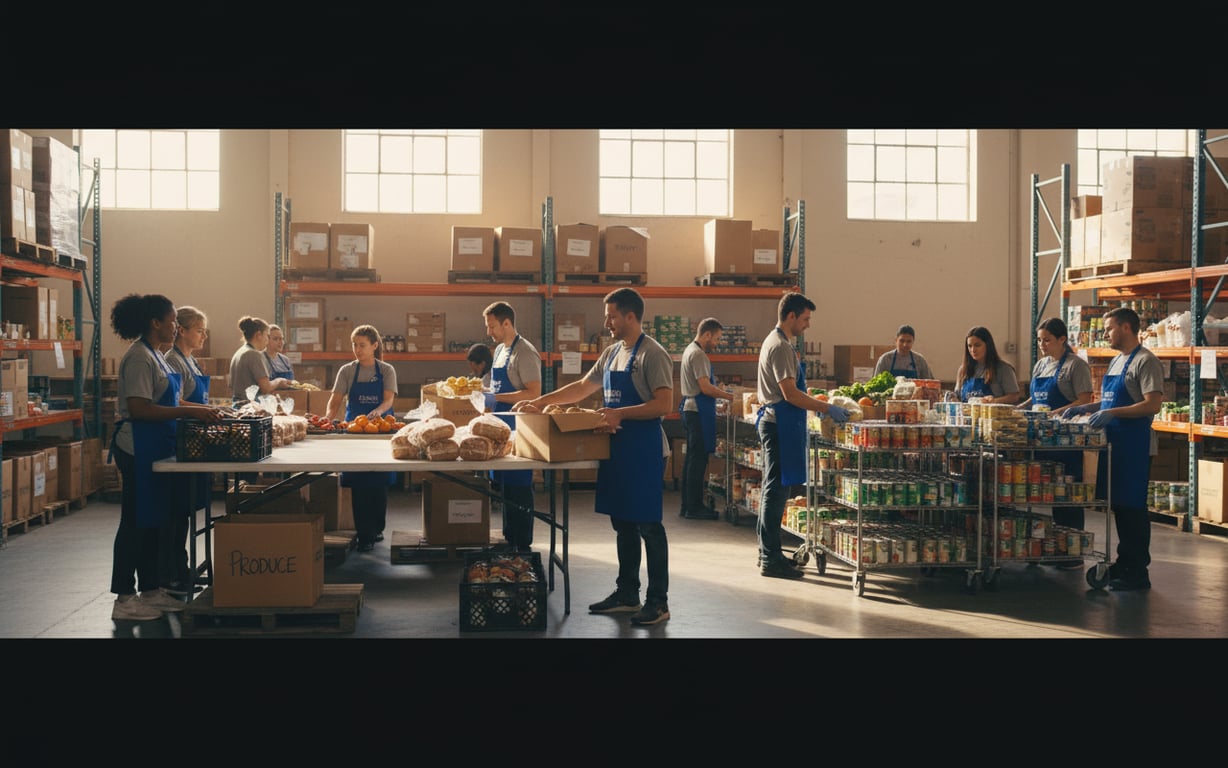
Food donation programs for retailers give unsellable but still-edible surplus a second use instead of sending it to landfill, and they form a core part of sustainable retail practices for food waste. Retail donations are already a significant redistribution channel: 21.5% – more than any other sector – was given as donations to those struggling with food insecurity, a figure that shows how central grocery retailers are to community food recovery efforts.
A structured program starts with regular collection arrangements with food banks, charities, or community kitchens, so surplus does not depend on an ad hoc phone call once a cooler is full. Staff need clear guidance on which products can be donated, when they should be pulled from sale, how they should be stored until pickup, and who coordinates the handoff, along with awareness of the liability protections that cover good-faith donations. Recording what gets donated, and from which departments, also helps retailers trace recurring surplus back to its source in forecasting or ordering, closing the loop between donation and prevention.
FAQ
What percentage of food do grocery stores waste each year? Industry data shows retailers generate millions of tons of surplus food annually, and roughly a third of that surplus ends up in landfill or incineration rather than being sold, donated, or repurposed.
How does better planning reduce food waste in retail? Better planning replaces reactive, intuition-based ordering with demand forecasting, shared supply chain visibility, and automated markdown timing, so surplus is prevented before it accumulates instead of being discounted after the fact.
What is the most common cause of food waste in supermarkets? Confusion over freshness date labels is the single largest reported cause, followed by produce spoilage and inventory that is overstocked relative to actual demand.
How can inventory management software lower spoilage rates? It forecasts demand at the day and item level, adjusts safety stock automatically, and flags items at risk of expiring before they are reordered unnecessarily.
What is FEFO and why does it matter for grocery stores? FEFO stands for first-expired, first-out, a stock rotation method that ensures products with the nearest expiry date are sold before newer stock, reducing waste from overlooked batches.
How do markdown strategies differ from clearance promotions? Markdowns are targeted price reductions on specific short-dated items, based on inventory and demand data, while clearance promotions are broader merchandising tactics such as bundling or recipe suggestions used to move slower-selling surplus.
Can small grocery stores afford food waste tracking technology? Many modern planning and tracking platforms are modular and scalable, so smaller stores can start with core forecasting or markdown features before expanding into full network-wide visibility tools.
What happens to donated food that stores cannot sell? Edible surplus that cannot be sold is typically collected by food banks, charities, or community kitchens through structured donation arrangements and redistributed to people facing food insecurity.
How does cold chain monitoring prevent spoilage? Connected temperature sensors alert staff the moment refrigeration conditions drift outside a safe range, allowing intervention before an entire case or display of product is compromised.
What ROI can retailers expect from investing in waste-reduction planning tools? Returns vary by store size and category mix, but documented outcomes include meaningful spoilage reductions, hours of staff time saved daily on manual ordering, and better product availability alongside lower waste.
Cutting food waste in grocery retail rarely comes down to a single fix. It is the cumulative effect of better forecasts, visible supply chains, protected cold chains, timely markdowns, consistent measurement, and structured donation routes working together. Retailers that start with one or two of these levers, measure the results, and expand from there tend to see the steadiest, most durable improvements in both waste and margin.


Comments