
The Ultimate Guide to Production Scheduling in Manufacturing: Systems, Methods, Tools & Algorithms


Production scheduling in manufacturing translates high-level production plans into precise, time-bound instructions for the shop floor — synchronizing labor, equipment, materials, and orders to meet delivery goals. It is a continuous process that depends on real-time visibility, enabling manufacturers to sequence jobs, manage bottlenecks, and adapt instantly to disruptions rather than defaulting to reactive firefighting.
Table of Contents
What is production scheduling in manufacturing
Production scheduling in manufacturing is the operational discipline that translates high-level production plans into precise, time-bound instructions for the shop floor. It answers the practical question of who does what, on which machine, in what order, and by when. Rather than a one-time exercise, scheduling is a continuous process that keeps every moving part of a factory — labor, equipment, materials, and orders — synchronized toward a common delivery goal.
So how does production scheduling work on a day-to-day basis? A scheduler (whether a person or a software system) constantly reconciles incoming customer orders against available capacity. That means checking machine availability, confirming raw materials have arrived, matching the right skilled labor to each task, and sequencing jobs to minimize costly changeovers. When a machine goes down or a supplier shipment is delayed, the schedule has to flex immediately rather than wait for the next planning cycle.
At its core, effective scheduling depends on visibility. Managers need a live picture of work-in-progress, queue times, and bottlenecks to make informed sequencing decisions. Without that visibility, plants default to reactive firefighting — expediting orders, running unplanned overtime, and missing delivery commitments. A well-run scheduling function, by contrast, turns the factory into a predictable system where output, cost, and lead time can all be forecast with confidence.
Production planning vs scheduling - understanding the difference
What is the difference between production planning and scheduling?
Manufacturers often use "planning" and "scheduling" interchangeably, but the two functions operate at very different altitudes. Production planning is the strategic, long-horizon process that determines what to produce, in what quantities, and with what overall capacity, typically looking weeks, months, or even quarters ahead. It balances forecasted demand against available resources at a macro level.
Production scheduling, by contrast, is the tactical, short-horizon execution layer. It takes the plan's output — approved production orders and capacity targets — and converts it into a detailed, shift-by-shift or hour-by-hour sequence of tasks on specific machines and workstations.
Where planning ends and scheduling begins is best understood as the moment a demand forecast becomes a firm, resource-assigned work order. Planning sets direction; scheduling makes it real on the floor, adapting continuously as breakdowns, rush orders, or material shortages occur.
Essential components of a production schedule
An effective production schedule is built from several interlocking components, each of which must be accurate for the plan to hold up under real-world pressure. Missing or outdated data in any one of these areas is often what causes a schedule to break down mid-shift.
Resource allocation: Labor, machinery, tooling, and materials assigned to specific tasks based on real, current availability rather than assumed capacity.
Demand alignment and timelines: Production volumes matched to customer orders and forecasts, with defined start and end times for every operation.
Inventory control: Ongoing tracking of raw material and component stock to avoid both production delays and excess carrying costs. Tools such as AI-driven inventory and replenishment systems help ensure the right stock is available exactly when the schedule calls for it.
Sequencing of operations: The logical order of tasks, designed to minimize setup and changeover time between jobs.
Lead times and buffer capacity: Supplier delivery windows and built-in slack to absorb unexpected disruptions without derailing the whole schedule.
Quality control checkpoints: Gated review points built into the schedule to uphold product standards without interrupting the broader production flow.
Bottleneck identification: Early detection of constrained resources so that scheduling constraints in manufacturing operations are addressed before they cause delays.
Scheduling constraints in manufacturing operations — limited machine hours, shift patterns, maintenance windows, and material availability — shape how these components fit together. A schedule that ignores real constraints looks tidy on paper but collapses on the shop floor. That's why quality control checkpoints and early bottleneck identification are treated as core components, not afterthoughts, in any mature production scheduling manufacturing process.
Types of production scheduling methods
Manufacturers can choose from several types of production scheduling methods, and the right choice depends heavily on product mix, order volume, and how much unpredictability the operation must absorb.
The first major decision is between infinite and finite capacity planning. Infinite capacity scheduling assumes unlimited resources, which makes it useful for rough long-range planning but unrealistic for daily execution. Finite capacity scheduling in manufacturing, on the other hand, accounts for actual constraints — machine hours, labor shifts, maintenance windows, and material limits — producing schedules that are far more likely to be achievable.
Directional scheduling techniques determine the order in which tasks are sequenced:
Job-based scheduling rounds out the picture for highly customized, low-volume production, where each order effectively has its own unique routing and timeline.
Perhaps the most significant shift in modern manufacturing is the move from static to dynamic scheduling. Static schedules assume nothing changes; dynamic scheduling continuously recalculates as disruptions occur. This agility is powered by production scheduling algorithms — mathematical and heuristic models that automatically re-sequence jobs, reallocate resources, and run "what-if" simulations, helping planners protect delivery dates and margins even when conditions shift unexpectedly.
How to build a production schedule step by step
Building a workable production schedule is an iterative process rather than a single calculation. The steps below outline how manufacturers typically move from raw demand data to an executable, monitored schedule:
Gather requirements and inputs: Review customer orders, historical trends, and demand forecasts; assess current raw material and component inventory; confirm labor and machinery availability.
Define objectives and constraints: Set output targets and quality standards while identifying capacity limits, lead times, and planned maintenance windows.
Break down the production process: List every task needed to manufacture the product, including any steps handled by outside vendors, and establish their logical sequence.
Estimate time and allocate resources: Calculate setup, processing, and changeover durations for each task, then assign specific machines, labor, and materials.
Develop a preliminary schedule: Sequence tasks within a draft timeline that respects capacity constraints and customer promise dates.
Optimize and finalize: Identify bottlenecks or over-allocated resources, rebalance workloads, and review the draft with key stakeholders.
Communicate and execute: Distribute the finalized schedule using visual tools such as Gantt charts or production boards so every department can begin work aligned to the same plan.
Monitor, adjust, and improve: Track real-time execution against the schedule, make adjustments as disruptions arise, and run post-production reviews to refine future cycles.
A crucial factor in executing this process reliably is moving beyond spreadsheets toward a dedicated production scheduling system. Platforms built for AI-driven manufacturing planning integrate inventory, capacity, and routing data into a single environment, automatically updating the schedule as conditions change and dramatically reducing the manual errors that plague spreadsheet-based approaches.
Production scheduling for small manufacturers
What scheduling approaches work best for small manufacturers?
Small manufacturers face a distinct version of the scheduling challenge: order volumes may be lower, but product variety, custom work, and tight margins leave little room for error. Many smaller shops start with flexible, informal methods like job-based scheduling, which suits low-volume, custom production well in the early stages.
As order volume grows, however, relying on flat spreadsheets or manual whiteboards quickly becomes a bottleneck. Production scheduling for small manufacturers doesn't require enterprise-scale complexity, but it does require moving beyond static files that can't keep pace with real-time changes in inventory or capacity.
A practical middle step is adopting a lightweight Material Requirements Planning (MRP) system. Unlike flat spreadsheets, these database-driven tools connect inventory data with production needs, often bundling demand forecasting, bill of materials (BOM) management, purchasing, and change tracking into one accessible source of truth. That lets even small teams coordinate procurement, production, and sales without the overhead of a full enterprise system, keeping the business agile when demand shifts or a supplier delay hits unexpectedly.

Manufacturing scheduling tools and software - what to look for
Key features to prioritize in a production scheduling system
ERP and MRP integration: A centralized database that synchronizes bills of materials, routing paths, and inventory levels automatically, preventing conflicts caused by missing components or outdated capacity assumptions.
Real-time visibility: Live machine uptime, labor shift status, and work-in-progress data surfaced in a single interface so planners can act on current conditions.
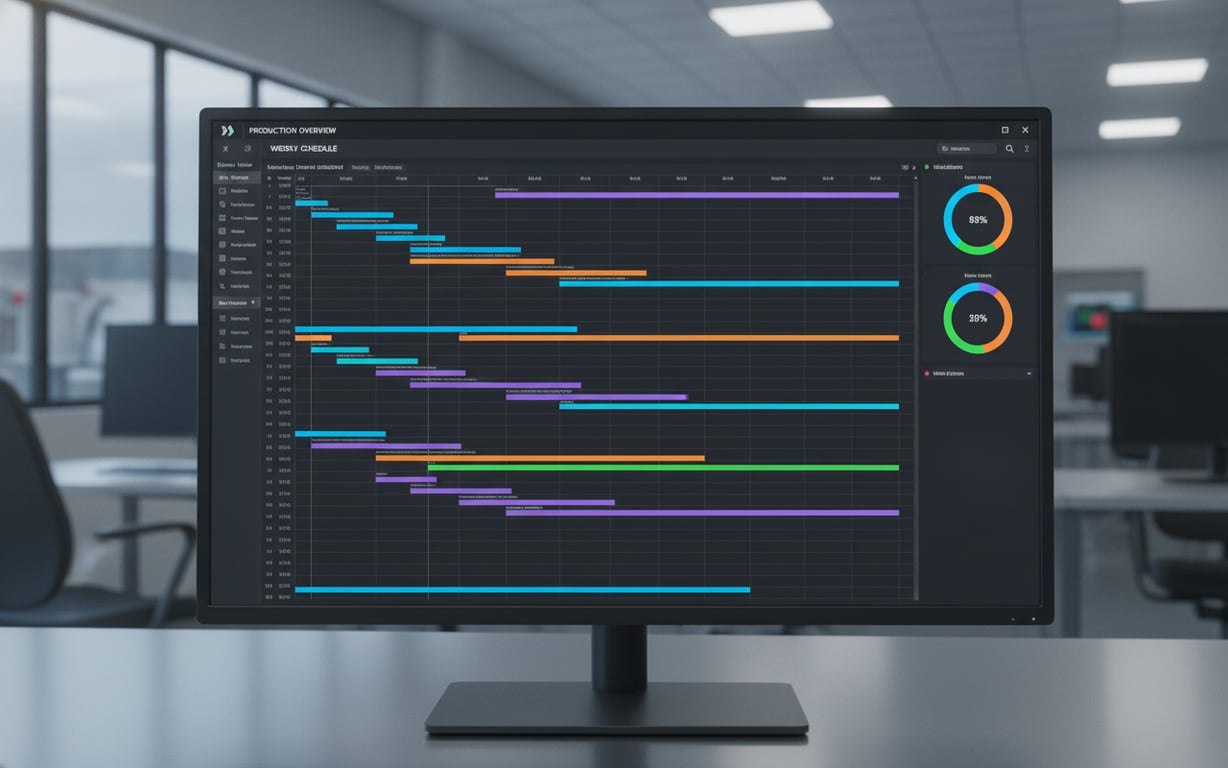
Flexible schedule management: Drag-and-drop schedule adjustments, automatic conflict detection, customizable calendars, and interactive Gantt charts.
Multiple scheduling methodologies: Support for finite, forward, and backward scheduling, since most manufacturers handle a mix of order types with different delivery requirements.
Broad departmental accessibility: Access for shop floor, sales, and management teams so everyone works from the same current information.
Advanced production scheduling algorithms: Models that run what-if capacity simulations, process incoming demand signals, and trigger autonomous rescheduling the moment a disruption occurs.
Predictive maintenance alerts: Flags for likely equipment failures before they halt production, reducing unplanned downtime.
Reporting dashboards: Built-in coverage of machine utilization, schedule adherence, and on-time delivery to support continuous improvement.
Choosing among manufacturing scheduling tools requires understanding how each platform handles the complexity of real shop floor variables. A capable production scheduling system should move beyond static spreadsheets, offering a centralized database that integrates with existing Enterprise Resource Planning (ERP) and Material Requirements Planning (MRP) software. That integration keeps bills of materials, routing paths, and inventory levels synchronized automatically, preventing conflicts caused by missing components or outdated capacity assumptions.
Real-time visibility matters just as much. Look for platforms that surface live machine uptime, labor shift status, and work-in-progress data, along with drag-and-drop schedule adjustments, automatic conflict detection, customizable calendars, and interactive Gantt charts. The system should also support multiple scheduling methodologies — finite, forward, and backward — since most manufacturers handle a mix of order types with different delivery requirements. Broad accessibility across departments, from the shop floor to sales, ensures everyone is working from the same current information, an approach reflected in comprehensive end-to-end planning and execution solutions now available to manufacturers.
Underneath the interface, the sophistication of the production scheduling algorithms determines how much real value the software delivers. Advanced systems use these models to run what-if capacity simulations, process incoming demand signals, and trigger autonomous rescheduling the moment a disruption occurs. Some platforms go further, layering in predictive maintenance alerts that flag likely equipment failures before they halt production. Finally, built-in reporting dashboards covering machine utilization, schedule adherence, and on-time delivery give manufacturers the feedback loop needed to continuously refine their scheduling approach.
Key benefits of optimized production scheduling
Optimized production scheduling manufacturing delivers benefits that extend well beyond simple shop-floor tidiness. By replacing static plans with dynamic, data-driven workflows, manufacturers can systematically address scheduling constraints in manufacturing operations such as limited machine hours, labor shifts, and material availability, turning what used to be recurring bottlenecks into manageable variables.
Improved employee productivity: Smart scheduling initiatives can drive up to a 20% improvement in employee productivity by balancing workloads and minimizing equipment idle time.
Increased usable capacity: Optimized scheduling can unlock as much as 15% in additional usable capacity without adding new equipment or headcount.
Reduced operating costs: Balanced workloads and minimized idle time translate into reduced unplanned overtime and fewer costly last-minute material expediting fees.
Better inventory management: Real-time visibility into work-in-progress and raw material stock levels helps prevent stockouts while avoiding the carrying costs of excess inventory.
Stronger delivery reliability: Precision scheduling allows manufacturers to commit to realistic lead times and consistently hit delivery deadlines, strengthening customer satisfaction.
Integrated quality control: Building quality control checkpoints directly into the schedule ensures product standards are upheld without interrupting the broader production flow.
The impact on resource efficiency and cost control can be substantial. Industry survey data suggests that smart scheduling initiatives can drive up to a 20% improvement in employee productivity and unlock as much as 15% in additional usable capacity, simply by balancing workloads and minimizing equipment idle time. Those gains typically translate into reduced unplanned overtime and fewer costly last-minute material expediting fees, while embedded quality checkpoints keep product standards intact without breaking production flow.
Common production scheduling challenges and how to overcome them
Even well-designed schedules are tested constantly by real-world disruptions. Supply chain volatility — material shortages, logistics delays, customs holdups — can stall an assembly line without warning. Demand variability and imprecise forecasting frequently lead to costly overproduction on one end or sudden stockouts on the other. On the floor itself, equipment breakdowns, workforce absences, and mid-run quality failures create immediate bottlenecks that ripple through every downstream task.
Managing scheduling constraints in manufacturing operations well means moving away from rigid, static plans toward finite capacity scheduling in manufacturing, which builds schedules around real, current limits rather than idealized assumptions. Several targeted strategies help manufacturers stay resilient:
Dynamic buffer management: Reserving a portion of machine capacity, typically 10% to 15%, to absorb rush orders and unexpected disruptions without derailing the full schedule.
Preventive maintenance: Scheduling routine servicing during low-demand windows to minimize unplanned downtime.
Cross-training and quality gates: Cross-training staff maintains continuity during absences, while gated quality checkpoints built into the schedule prevent costly late-stage rework.
Enhanced collaboration: Database-driven systems that align procurement, sales, and suppliers under a single source of truth eliminate the communication silos that so often turn a small delay into a full schedule breakdown, a principle at the heart of modern operations and supplier collaboration platforms.

Frequently Asked Questions
What is the main goal of production scheduling in manufacturing? The main goal is to sequence tasks, resources, and timelines so that production orders are completed on time, at the right cost, and to the required quality standard, while keeping machines and labor efficiently utilized.
How often should a production schedule be updated? Most manufacturers update schedules continuously or at least once per shift, since conditions like material availability, machine status, and order priority can change throughout the day.
What is the difference between finite and infinite capacity scheduling? Finite capacity scheduling accounts for real constraints like machine hours and labor shifts, producing achievable schedules, while infinite capacity scheduling assumes unlimited resources and is better suited to rough, long-range planning.
Can small manufacturers use the same scheduling methods as large enterprises? Small manufacturers can apply the same principles but typically need lighter-weight tools, such as a simple MRP system, rather than the full-scale platforms used by large, high-volume operations.
What role do production scheduling algorithms play? These algorithms automatically recalculate sequences, allocate resources, and run what-if simulations, enabling dynamic rescheduling in response to disruptions far faster than manual replanning.
Is a spreadsheet enough for production scheduling? Spreadsheets can work for very simple, low-volume operations, but they quickly become error-prone and hard to maintain as order volume, product variety, or complexity increases.
How does production scheduling reduce costs? By minimizing idle machine time, reducing unplanned overtime, avoiding rush material expediting fees, and preventing both stockouts and excess inventory, optimized scheduling directly lowers operating costs.
What is backward scheduling used for? Backward scheduling starts from a required delivery date and works backward to determine when each task must begin, making it well suited for custom, make-to-order products with firm deadlines.
How do scheduling constraints affect a production plan? Constraints such as limited machine hours, labor shifts, and material availability determine how realistic a schedule is; ignoring them leads to plans that look good on paper but fail on the shop floor.
What features should manufacturers prioritize in scheduling software? Priorities include ERP/MRP integration, real-time visibility into machine and labor status, support for multiple scheduling methods, drag-and-drop adjustments, and strong reporting on utilization and on-time delivery.


Comments