
Replenishment Optimization: Mastering Automated Inventory Replenishment for Supply Chain Excellence


Replenishment optimization is the discipline of determining precisely when, how much, and from where to reorder inventory so that products are available when customers need them — without tying up excessive capital in surplus stock. Unlike traditional inventory management, which relies on fixed reorder points, manual purchase orders, and periodic reviews, modern replenishment optimization uses real-time data, predictive analytics, and algorithmic decision-making to continuously calibrate stock levels across every location in a supply chain.
What is replenishment optimization and why it matters
The distinction matters enormously in practice. Traditional approaches treat inventory replenishment as a reactive process: a warehouse runs low, a manager notices, and a purchase order is raised. Replenishment optimization flips this model. It anticipates demand before shortages occur, accounts for supplier lead times, seasonal fluctuations, and promotional events, and triggers orders automatically at the mathematically optimal moment. The result is a supply chain that operates proactively rather than defensively.
Why does this matter for U.S. retailers and distributors? Industry research suggests U.S. retailers lose tens of billions of dollars annually to stockouts and overstocks combined. Carrying costs for excess inventory typically run between 20% and 30% of the inventory's value per year, while a single stockout event can permanently redirect a customer to a competitor. A well-tuned replenishment strategy attacks both problems simultaneously — reducing carrying costs while improving product availability and customer satisfaction scores.
For operations professionals, the shift toward supply chain replenishment optimization also means better cross-functional alignment. Procurement, logistics, finance, and store operations all benefit when inventory decisions are grounded in shared, accurate data rather than departmental guesswork. This foundational alignment is what separates high-performing supply chains from those perpetually firefighting shortages and write-downs.
Inventory optimization fundamentals for effective replenishment
Effective replenishment planning rests on a set of core inventory optimization principles that apply regardless of whether a business operates a single retail location or a multi-node distribution network. Understanding these fundamentals is the prerequisite for any successful replenishment program.
Demand visibility: Accurate, granular demand data — broken down by SKU, location, channel, and time period — is the raw material of every replenishment decision. Without it, even the most sophisticated algorithms produce unreliable outputs. Businesses should invest in point-of-sale integration, e-commerce data feeds, and historical sales cleansing before attempting advanced optimization.
Safety stock calibration: Safety stock is the buffer inventory held to absorb variability in both demand and supply. The classic formula is: Safety Stock = Z × σ_LT × √LT, where Z is the service-level factor (for 95% service level, Z ≈ 1.65), σ_LT is the standard deviation of demand during lead time, and LT is the average lead time in days. Many businesses set safety stock arbitrarily; optimizing it to actual variability data can reduce carrying costs by 15–25% while maintaining or improving fill rates.
Reorder point accuracy: The reorder point (ROP) is calculated as: ROP = (Average Daily Demand × Lead Time) + Safety Stock. This simple formula becomes powerful when average daily demand and lead time are updated dynamically rather than set once and forgotten.
Economic order quantity (EOQ) awareness: EOQ balances ordering costs against holding costs to identify the most cost-efficient order size: EOQ = √(2DS/H), where D is annual demand, S is the cost per order, and H is the annual holding cost per unit. For demand replenishment planning, EOQ provides a rational starting point that can then be adjusted for supplier minimums, volume discounts, and transportation constraints.
Together, these principles form the analytical backbone that makes stock replenishment decisions defensible, measurable, and continuously improvable. Businesses that master them gain a structural cost advantage over competitors still relying on intuition and spreadsheets. For a deeper exploration of how these fundamentals connect to broader advanced replenishment optimization strategies, including predictive modeling and multi-echelon approaches, the analytical framework described here serves as the essential starting point.
Automated replenishment systems and how they work
What is an automated replenishment system?
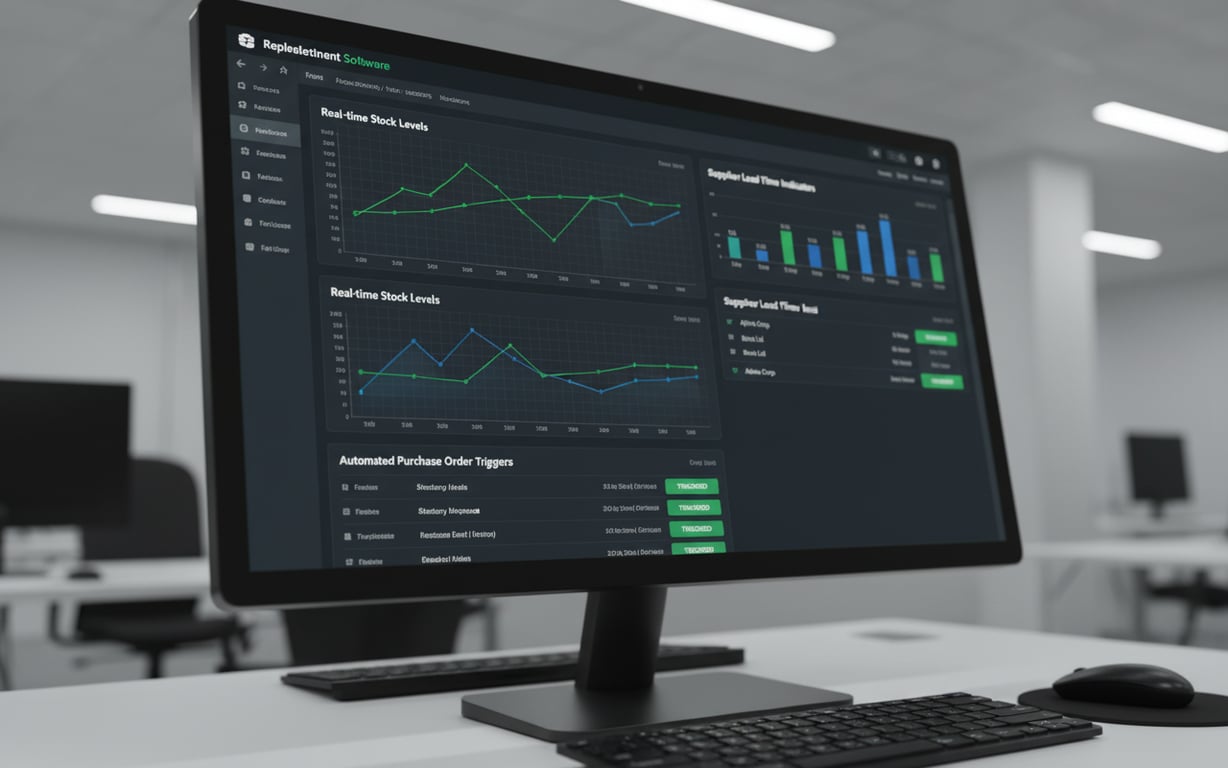
An automated replenishment system is software — often integrated with an ERP, WMS, or POS platform — that monitors inventory levels in real time and generates replenishment orders without requiring manual intervention for routine decisions. Understanding what is auto replenishment, at a technical level, helps operations teams evaluate vendors and set realistic expectations for implementation.
How an auto replenishment system works
The system ingests live inventory data from warehouses, stores, and in-transit shipments.
It compares current stock levels against dynamically calculated reorder points.
When stock falls to or below the ROP, the system automatically generates a purchase order or transfer order.
The order is routed for approval (or auto-approved within defined parameters).
The order is transmitted to the supplier or upstream warehouse.
Modern replenishment software layers several additional technologies on top of this basic loop. Machine learning algorithms analyze historical sales patterns, promotional calendars, weather data, and macroeconomic indicators to produce demand forecasts that are far more accurate than simple moving averages. Some platforms also incorporate supplier performance data — tracking on-time delivery rates and fill rates by vendor — to dynamically adjust lead time assumptions and safety stock levels.
Integration architecture is critical. Best-in-class auto replenishment system platforms connect via APIs to ERP systems such as SAP or Oracle, warehouse management systems, transportation management systems, and supplier portals. This connectivity ensures that a single source of truth governs all inventory decisions, eliminating the data silos that cause costly discrepancies between what the system thinks is in stock and what is physically available.
Cloud-based deployment has become the dominant model for replenishment software in the U.S. market, offering scalability, automatic updates, and lower upfront infrastructure costs compared to on-premise alternatives. For retail businesses evaluating AI-driven inventory and replenishment solutions, cloud-native platforms that combine demand forecasting with automated order generation represent the current state of the art.
Stock replenishment strategies for different business needs
No single replenishment strategy fits every business. The right approach depends on demand variability, product margins, supplier relationships, storage constraints, and service-level commitments. Understanding the primary strategies — and the conditions under which each excels — allows operations managers to build a tailored framework for stock replenishment.
Continuous Review (Fixed Reorder Point)
How It Works: Inventory monitored continuously; order triggered when stock hits the reorder point at a fixed quantity (often EOQ)
Best For: High-velocity, high-value SKUs with stable demand
Key Drawback: Requires real-time inventory visibility
Periodic Review (Fixed Interval)
How It Works: Orders placed at fixed intervals; quantity varies to reach a target level
Best For: Grocery and foodservice distribution
Key Drawback: Higher average inventory levels due to extended safety stock coverage
Min/Max Replenishment
How It Works: Order placed when stock hits minimum; restocked to maximum
Best For: Warehouse replenishment; widely supported in WMS platforms
Key Drawback: Parameters become stale without regular review
Vendor-Managed Inventory (VMI)
How It Works: Supplier monitors stock and initiates replenishment orders
Best For: Consumer packaged goods with large, reliable suppliers
Key Drawback: Requires deep data sharing and strong supplier trust
Just-in-Time (JIT)
How It Works: Inventory arrives precisely when needed, minimizing holding costs
Best For: Manufacturing with predictable demand
Key Drawback: High risk during supply chain disruptions
Selecting the right inventory replenishment approach often means combining strategies: applying continuous review to top-selling SKUs, periodic review to slower movers, and VMI to commodity inputs. A well-designed replenishment order framework documents which strategy applies to which product category and reviews those assignments at least annually. Businesses can also explore automatic replenishment and allocation tools that apply the optimal strategy per SKU dynamically, removing the need for manual category assignments.
Warehouse replenishment processes and best practices
Warehouse replenishment refers specifically to the movement of inventory from bulk storage or receiving areas into active pick locations — the forward-facing slots from which orders are fulfilled. This internal process is distinct from purchasing replenishment (ordering from suppliers) but equally critical to operational efficiency.
Standard warehouse replenishment workflow
The WMS monitors pick location inventory levels in real time, comparing current quantities against minimum thresholds.
When a pick location falls below its minimum, the system generates a replenishment task.
A warehouse associate (or an automated guided vehicle in more advanced facilities) retrieves the required quantity from bulk storage.
The pick location is restocked and the transaction is recorded in the WMS.
If bulk storage is also depleted, a purchase order or inbound transfer is triggered to replenish the reserve location.
Warehouse replenishment best practices
Slotting optimization: Placing fast-moving SKUs in the most accessible pick locations reduces travel time and replenishment frequency simultaneously.
Replenishment task prioritization: Ensures that pick locations supporting active orders are restocked before those with adequate buffer.
Cross-docking: Inbound product bypasses storage and flows directly to outbound staging, eliminating replenishment steps entirely for high-velocity items.
Cycle counting: Maintains inventory accuracy, which is the foundation of reliable replenishment triggers.
Labor planning: Aligning replenishment staffing with peak picking periods prevents the bottleneck where pickers outpace replenishment workers.
Industry benchmarks suggest that best-in-class distribution centers maintain pick location fill rates above 99.5% and replenishment task completion times under 30 minutes. Facilities that fall below 98% fill rates typically experience measurable order fulfillment delays and increased expediting costs. Accurate replenishment planning at the warehouse level is therefore not just an operational nicety — it is a direct driver of customer service performance and a cornerstone of reliable stock replenishment.
Replenishment software capabilities and selection criteria
Choosing the right replenishment software is one of the highest-leverage decisions an operations team can make. The market ranges from basic reorder-point modules embedded in legacy ERP systems to purpose-built, AI-powered platforms that manage multi-echelon inventory across hundreds of locations. Evaluating options requires a clear understanding of which capabilities are essential versus nice-to-have.
Core capabilities every replenishment platform should offer
Real-time inventory visibility: Across all locations and channels
Configurable reorder point and safety stock calculations: Adaptable to your specific business rules
Demand forecasting: With at least seasonal decomposition
Automated purchase order generation and supplier communication: Reducing manual intervention for routine decisions
System integration: With existing ERP, WMS, and POS systems via standard APIs
Advanced capabilities that differentiate leading platforms
Machine learning-based demand forecasting: Incorporates external signals such as weather, promotions, and economic indicators
Multi-echelon optimization: Simultaneously balances inventory across distribution centers and stores
Exception management dashboards: Surface only the decisions requiring human judgment
Supplier performance tracking: Feeds back into lead time and safety stock calculations
Scenario modeling tools: Allow planners to simulate the inventory impact of demand spikes, supplier disruptions, or new product launches
Five criteria for evaluating automated replenishment vendors
Integration depth: How seamlessly does the platform connect with your existing technology stack?
Configurability: Can the system accommodate your specific business rules, supplier constraints, and product hierarchies?
Scalability: Will the platform handle your SKU count and location count as the business grows?
Total cost of ownership: What are the implementation, licensing, and ongoing support costs relative to the projected inventory savings?
Vendor expertise: Does the provider have demonstrated experience in your industry vertical?
For businesses seeking inventory optimization at scale, platforms that combine AI-driven forecasting with automated replenishment execution — such as those offered through end-to-end inventory planning solutions — deliver the most comprehensive capability set, reducing the need to integrate multiple point solutions.
Benefits of automated replenishment for supply chain performance
The business case for automated replenishment is well-documented across industries. Organizations that implement structured replenishment optimization programs consistently report improvements across four performance dimensions: inventory efficiency, service levels, labor productivity, and financial performance.
Inventory efficiency: Automated replenishment typically reduces overall inventory levels by 10–30% while simultaneously improving product availability. This is possible because the system right-sizes safety stock based on actual demand variability rather than conservative manual estimates. A regional grocery chain that moves from manual reordering to automated replenishment, for example, might reduce its average inventory days-on-hand from 18 to 13 days — freeing millions of dollars in working capital without sacrificing fill rates.
Service level improvements: Automated systems maintain fill rates above 98% by ensuring reorder points are always current and orders are placed without the delays inherent in manual processes. For e-commerce businesses, where customers expect same-day or next-day fulfillment, even a 1% improvement in in-stock rates can translate to a measurable increase in revenue.
Labor productivity gains: Eliminating the manual work of monitoring stock levels, generating purchase orders, and chasing supplier confirmations frees planners to redirect their capacity to exception management, supplier negotiations, and strategic planning — higher-value activities that compound over time.
Financial performance: The combination of lower inventory carrying costs, reduced stockout losses, and improved labor efficiency typically delivers a return on investment within 12–18 months for mid-market retailers. Supply chain replenishment optimization is, in this sense, one of the most reliably high-ROI investments available to operations leaders, and a defining feature of mature inventory optimization programs.
Common challenges in inventory replenishment and solutions
Even well-designed inventory replenishment programs encounter obstacles. Recognizing the most common challenges — and having proven solutions ready — is what separates implementations that deliver lasting value from those that stall after initial deployment.
Data quality: Replenishment algorithms are only as good as the data they consume. Inaccurate inventory records, missing demand history for new SKUs, and inconsistent supplier lead time data all degrade forecast accuracy and trigger incorrect orders. The solution is a data governance program that includes regular cycle counting, systematic lead time tracking by supplier and SKU, and a process for seeding new-item forecasts with analogous product history.
Demand variability and seasonality: Standard stock replenishment models struggle with highly seasonal products, promotional spikes, and new product introductions. The fix is a demand forecasting layer that explicitly models seasonality, incorporates promotional calendars, and applies statistical methods such as exponential smoothing or ARIMA models to volatile SKUs. Businesses can deepen their forecasting capabilities by consulting resources like this complete guide to retail forecasting methods, which covers essential demand replenishment techniques applicable to replenishment planning.
Supplier reliability: When suppliers miss delivery windows or ship partial orders, replenishment plans built on assumed lead times break down. The solution is to track actual versus promised lead times by supplier, build supplier-specific safety stock buffers, and maintain approved alternate sources for critical SKUs.
Organizational resistance: Planners who distrust algorithmic recommendations and override them manually represent a softer but equally real challenge. Addressing it requires transparent model explanations, a structured exception review process, and a change management program that demonstrates early wins to build confidence in the system.

Implementing replenishment optimization in your organization
Successful implementation of replenishment optimization follows a structured progression from diagnostic assessment through technology deployment to continuous improvement. Rushing any phase increases the risk of a technically sound system that fails to deliver business results.
Five-phase implementation approach
Assessment and Baseline (Weeks 1–4): Begin by auditing current inventory performance. Calculate your existing fill rates, inventory turns, days-on-hand, and stockout frequency by product category. Identify the top 20% of SKUs that drive 80% of revenue and the top sources of inventory variance. This baseline establishes the ROI benchmark against which future improvements will be measured.
Data Infrastructure (Weeks 4–8): Ensure that your inventory data is accurate, complete, and accessible. This means reconciling physical counts with system records, establishing a process for capturing actual supplier lead times, and confirming that your POS or order management system feeds clean demand data into your replenishment platform. Data infrastructure work is unglamorous but non-negotiable.
Strategy Design (Weeks 6–10): Define which strategy applies to which product segments as part of your overall replenishment planning approach. Assign continuous review to high-velocity, high-margin SKUs; periodic review to slower movers; and VMI to appropriate supplier relationships. Set initial safety stock and reorder point parameters using the formulas described earlier, calibrated to your actual demand variability and lead time data.
Technology Configuration and Testing (Weeks 8–14): Configure your automated replenishment software with the defined strategies and parameters. Run parallel testing — allowing the system to generate recommendations while planners continue manual ordering — to validate accuracy before going live. Measure the system's suggested orders against actual outcomes and refine parameters iteratively.
Go-Live and Continuous Improvement (Week 14+): Transition to automated order generation for approved SKU segments. Establish a weekly exception review cadence where planners address the small percentage of situations the algorithm flags for human judgment. Review and update safety stock and reorder point parameters quarterly, or whenever significant changes in demand patterns or supplier performance occur.
Organizations that follow this phased approach typically achieve stable, optimized replenishment within six months and continue to realize incremental improvements as the system accumulates more demand history and the team builds confidence in algorithmic decision-making. The investment in structured inventory optimization rollout pays dividends in the form of a supply chain that is genuinely self-regulating — freeing leadership to focus on growth rather than operational firefighting.
Frequently Asked Questions
What is the difference between replenishment optimization and traditional inventory management? Traditional inventory management typically relies on fixed reorder points, manual purchase orders, and periodic reviews that react to shortages after they occur. Replenishment optimization uses real-time data, demand forecasting, and algorithmic decision-making to anticipate needs before stockouts happen, continuously adjusting order timing and quantities based on actual demand variability, supplier performance, and service-level targets.
How does an automated replenishment system determine when to place an order? It calculates a dynamic reorder point for each SKU based on average daily demand, supplier lead time, and a safety stock buffer sized to the desired service level. When real-time inventory falls to or below that reorder point, the system automatically generates a purchase or transfer order. Advanced systems also incorporate demand forecasts and promotional calendars to anticipate spikes before they deplete stock.
What is safety stock, and how should it be calculated? Safety stock is buffer inventory held to absorb unexpected demand spikes or supplier delays. The standard formula is: Safety Stock = Z × σ_LT × √LT, where Z is the service-level factor (1.65 for 95% service level), σ_LT is the standard deviation of demand during lead time, and LT is average lead time. Setting safety stock based on actual variability data — rather than arbitrary rules of thumb — typically reduces carrying costs by 15–25% while maintaining fill rates.
Which replenishment strategy is best for a retail business with highly seasonal products? Seasonal products are best managed with a continuous review strategy combined with a demand forecasting layer that explicitly models seasonality. Safety stock parameters should be adjusted upward during peak season ramp-up periods and downward during off-season to avoid excess end-of-season inventory. Some businesses also use periodic review with a variable order-up-to level that changes by season, which simplifies supplier scheduling while accommodating demand variability.
How long does it typically take to implement replenishment optimization? A structured implementation following the five-phase approach — assessment, data infrastructure, strategy design, technology configuration, and go-live — typically takes 14 to 20 weeks for mid-market retailers. Larger enterprises with more complex multi-echelon networks may require 6 to 12 months. The most common cause of delays is data quality remediation, which underscores the importance of investing in data infrastructure before configuring replenishment algorithms.
What ROI can businesses expect from automated replenishment? Most mid-market retailers achieve full return on investment within 12 to 18 months. Typical benefits include a 10–30% reduction in overall inventory levels, fill rate improvements to above 98%, and significant labor savings from eliminating manual order generation. The financial impact comes from three sources: reduced inventory carrying costs (typically 20–30% of inventory value annually), lower stockout losses, and improved planner productivity redirected to higher-value activities.
How does vendor-managed inventory (VMI) differ from automated replenishment? In a standard automated replenishment model, the buyer's system monitors stock and generates orders. In VMI, the supplier takes responsibility for monitoring the buyer's inventory levels and initiating replenishment. VMI requires deep data sharing — the buyer grants the supplier visibility into their inventory and sales data — and works best with large, reliable suppliers who have the systems and incentive to manage the buyer's stock efficiently.
What data is required to run an effective replenishment optimization program? The minimum data requirements are: accurate on-hand inventory by SKU and location, historical sales or demand data (ideally 12–24 months), supplier lead times by vendor and SKU, and current open purchase orders. Advanced programs also incorporate promotional calendars, seasonal indices, supplier fill rate history, and external demand signals such as weather or economic indicators. Data quality — accuracy, completeness, and timeliness — matters more than data volume.
Can small businesses benefit from replenishment optimization, or is it only for large enterprises? Small businesses can absolutely benefit, and the relative impact is often larger because they have less margin for error. Cloud-based replenishment software has dramatically lowered the cost of entry, with many platforms offering subscription pricing accessible to businesses with modest SKU counts. Even implementing the basic reorder point and safety stock formulas in a spreadsheet represents a meaningful improvement over purely intuitive ordering for small retailers.
How should businesses measure the success of their replenishment optimization program? The primary KPIs are: inventory fill rate (target: above 98%), inventory turns (compare against industry benchmarks for your category), days-on-hand (lower is generally better, within service-level constraints), stockout frequency (number of SKU-days with zero inventory), and excess inventory as a percentage of total inventory value. These metrics should be tracked at the SKU and category level, reviewed weekly, and benchmarked against pre-implementation baselines to quantify the program's ongoing value.


Comments