
Private Label Optimization: The Ultimate Guide to Building a Successful Brand with a Winning Pricing Strategy
- Andra Palade

- 17 hours ago
- 9 min read

Private label optimization is the coordinated use of market research, supplier management, quality control, packaging, and pricing strategy to make a retailer's own-brand products a genuine growth driver rather than a discount fallback. Store brands generated a record $271 billion in U.S. retail sales in 2024 and have continued climbing since, growing faster than national brands for several consecutive years. Retailers such as Costco, whose Kirkland Signature line reached approximately $90 billion in annual sales, show what a fully optimized private label brand can achieve.
Table of Contents
What is private label optimization
Let me set the scene: private label optimization is what happens when a retailer stops treating its store brand as the sad cousin on the bottom shelf and starts running it like a real business. That means data-driven decisions across product research, sourcing, quality assurance, packaging, and pricing — all working together to make own-brand products actually compete with the big names for shelf space and shopper loyalty.
And the numbers are why I get genuinely excited about this shift. Private label sales hit a record $271 billion in 2024, outpacing national brand growth for the first time in decades, and the category has kept climbing since. Don't chalk this up entirely to tight household budgets, either — premium store brands now account for 40% of private-label spend, which tells me shoppers are choosing these products on merit, not just because they're cheaper.
For retail teams, this means quarterbacking every stage of a private label brand's life — from concept through supplier vetting, manufacturing oversight, packaging, and pricing — so the finished product holds its own against manufacturer brands while protecting the fat margin that made the whole thing worth doing.
What makes a private label brand successful
A successful private label brand earns loyalty by matching or beating national brand quality while giving shoppers a clear reason to pick it up — value, exclusivity, or an experience they can't get anywhere else. Retailers structure their private labels across a three-tier hierarchy of generic, classic, and premium lines, which gives them control over price perception, assortment depth, and positioning all at once.
From what I've seen, the retailers who nail it tend to share a few traits:
Consistent quality: Products meet or beat the sensory and functional performance of the national brand equivalent.
Clear tier positioning: Shoppers can immediately tell whether an item is a value, mainstream, or premium offering.
Exclusivity: Unique formulations or flavors that you literally cannot buy anywhere else — that's the destination effect Trader Joe's and Costco have turned into an art form.
Design investment: Packaging and branding read as intentional, not stripped-down substitutes.
Sub-branding discipline: Umbrella brands with targeted sub-lines allow differentiation without confusing the overall architecture.
Private label vs national brand differences
Here's where the private label vs national brand differences really come into focus: it comes down to who owns the brand, how it's marketed, and where the margin lands. A private label item is owned and specified by the retailer and sold exclusively through that retailer's stores and channels. A national brand is manufactured and marketed independently, then distributed across a lot of competing retailers.
This is exactly why private label margins for grocery retailers typically top 40%, compared to 25 to 35% for national brands sitting on the same shelves. Cut out the separate manufacturer marketing and distribution costs, and that margin gap opens right up.
Private label market research and product research process
Solid private label market research tells you which categories and product gaps are actually worth pursuing before you develop a single formulation. And it's not one research task — it's a sequence, and skipping steps is where I've seen brands burn budget.
Audit the current assortment and competitor offerings to locate gaps where the retailer's own brand could add differentiated value.
Mine consumer feedback, online reviews, and social listening data to understand unmet needs and emerging preferences.
Benchmark national brand pricing and quality positioning within the target category.
Prototype and taste-test or sample-test candidate formulations with target shoppers.
Validate demand using sales history, forecasting models, and category trend data before committing to full production.
This whole private label product research process is increasingly driven by consumer feedback, online reviews, and digital analytics, which lets teams launch faster and iterate on products already in market. It also feeds directly into assortment planning decisions, because a private label candidate has to earn its spot in the broader category — you can't evaluate it in a vacuum.
Private label supplier selection criteria
Private label supplier selection is where a program either builds momentum or quietly falls apart, so vetting has to go way beyond price quotes. The retailers I trust most look at manufacturers across several interconnected criteria before anyone signs a contract.
Quality certifications and track record: Verified food safety, manufacturing, or industry-specific certifications relevant to the category.
Production capacity and scalability: Ability to meet current volume needs and scale as the private label brand grows.
Cost transparency: Willingness to share real-time cost breakdowns rather than opaque unit pricing.
Collaboration and forecast sharing: Suppliers who accept shared demand forecasts and production schedules can plan capacity and raw material procurement more accurately, reducing lead times.
Financial stability: Suppliers able to weather raw material and logistics volatility without disrupting supply.
Strategic sourcing has moved toward centralized sourcing teams, digital tender tools, and increased supplier competition, which together sharpen your negotiating leverage. That's the same discipline behind category management in procurement, where supplier relationships get managed systematically instead of hashed out deal by deal.
Private label manufacturing process overview
The private label manufacturing process takes a product from spec sheet to shelf through a series of distinct stages, and each one demands retailer sign-off before anything moves forward.
Define the product brief: formulation or design specifications, target price point, and positioning within the brand's tier structure.
Issue a tender or request for proposal to shortlisted manufacturers and compare cost, capacity, and quality credentials.
Develop and approve pre-production samples, adjusting formulation or materials until specifications are met.
Finalize packaging artwork, labeling compliance, and regulatory approvals.
Run initial production, subject to quality inspection before full-scale manufacturing begins.
Coordinate logistics and replenishment planning so inventory reaches stores or fulfillment centers in line with the launch date.
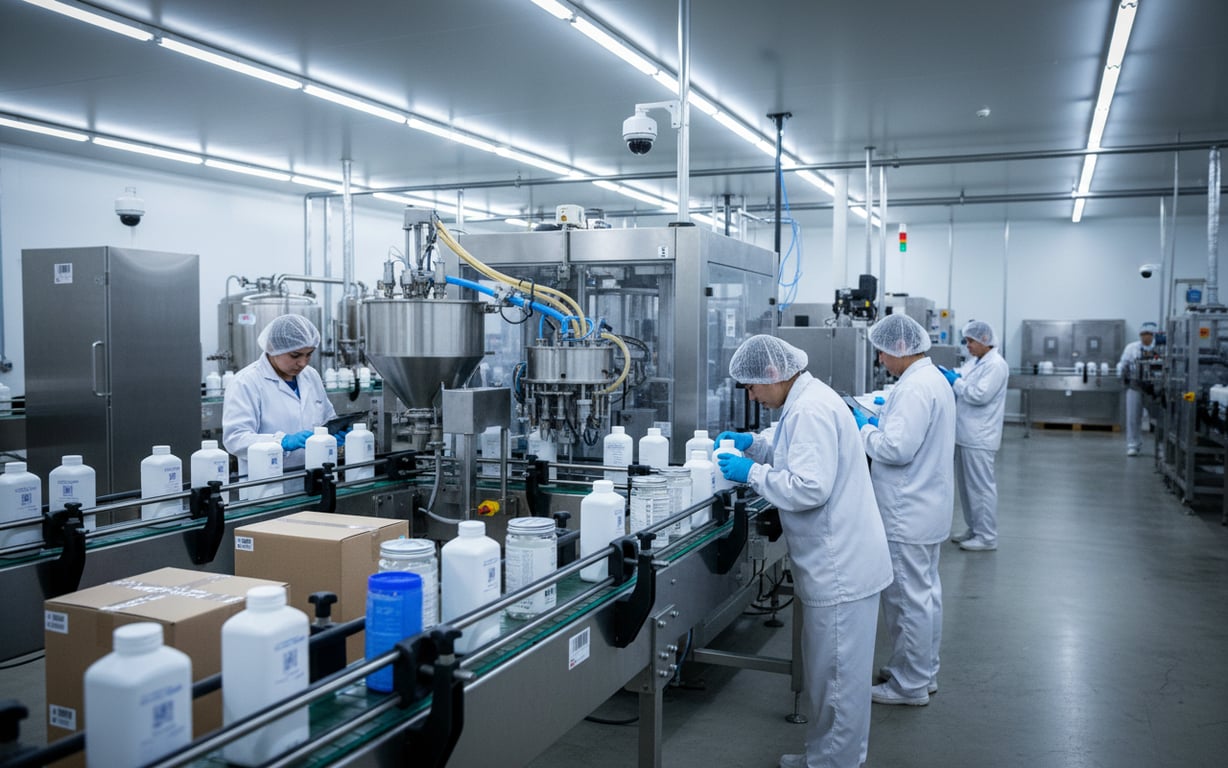
Products can be developed in-house or sourced as white-label goods when in-house development isn't feasible, with strict quality control applied in either case — because at the end of the day, the retailer's name is on that box no matter who made it.
Private label quality control checklist
A rigorous private label quality control checklist is what makes sure every batch delivers on the brand's promise before a shopper ever touches it. At minimum, I'd verify the following at each stage:
Raw material inspection: Confirm incoming ingredients or components match approved specifications.
In-process checks: Monitor production runs for consistency in weight, appearance, and formulation.
Pre-shipment inspection: Sample finished goods before they leave the factory to catch defects early.
Labeling and compliance review: Verify claims, ingredients, and regulatory labeling are accurate and legally compliant.
Consumer feedback loop: Route post-launch reviews and complaints back into future production specifications.
The retailer's own name is on the package, which means a quality slip damages the entire store's reputation, not some distant manufacturer's. That's why this checklist is non-negotiable — it's not an optional add-on, it's the whole ball game.
Private label packaging design tips
Great private label packaging design is often the deciding factor in whether a shopper reaches for your product or drifts back to the national brand. Sleek package design paired with high quality standards is exactly how private label products have transformed from generic afterthoughts into sought-after brands in their own right — leaving the plain, budget-signaling packaging of decades past far behind.

Good packaging should signal the product's tier at a glance — premium lines benefit from richer materials and restrained typography, while value lines still need to look intentional, not generic. Sustainability cues like recyclable materials or transparent sourcing claims land well with shoppers weighing environmental impact alongside price. And a word of caution: leaning too close to a leading national brand's design has triggered some very public trademark disputes in this industry. Distinctive, ownable design builds far stronger long-term brand equity than mimicking a competitor's shelf presence ever will.
Private label pricing strategy and profit margin factors
A smart private label pricing strategy sets the retail price low enough to pull in value-conscious shoppers while protecting the margin advantage that justified the whole investment. Most retailers anchor private label prices to a defined discount relative to the leading national brand rather than pricing in a vacuum.
Image suggestion: A dashboard visualizing private label versus national brand pricing and margin comparisons.
Several private label profit margin factors determine how much margin a given item can realistically capture. Category price sensitivity matters a lot: staple household goods tolerate less markup than specialty or premium items. Key Value Items — the handful of highly visible products that anchor a shopper's price perception of the whole store — deliberately run thinner margins, while less price-sensitive items in the same category absorb higher margins to balance things out. Promotional cadence plays into realized margin too, since discounting drives trial and volume but has to be weighed against cannibalizing full-price sales. And because market conditions never stop shifting, pricing relationship rules need ongoing tuning, not a one-time setup. That's exactly the discipline behind a broader retail price planning strategy, which aligns pricing decisions with competitive positioning and margin targets across the full assortment.
How to optimize private label products with SEO keyword strategy
Figuring out how to optimize private label products for search means treating each product listing as a direct competitor for the same terms shoppers use to find national brands. On marketplaces and retailer sites alike, product titles, backend search terms, and category tags need to mirror how customers actually phrase their searches — not the internal product naming conventions your team happens to prefer.
A few tactics I've watched consistently move the needle on private label SEO keyword strategy:
Keyword-rich titles and descriptions: Include the generic product term, key attributes, and use-case language shoppers search for.
Review mining: Extract recurring phrases from customer reviews to identify search terms not yet targeted.
Image and alt-text optimization: Ensure product images carry descriptive metadata to support both search engines and marketplace algorithms.
Comparison-term targeting: Many shoppers now search for lower-cost alternatives to specific branded products, so listings should capture that comparison intent without infringing on trademarks.
Here's a humbling stat: only 3% of Amazon's total sales volume comes from its private label lines — the lowest share of any major retailer. That's a reminder that digital placement alone won't save you. Strong search visibility only pays off when it's paired with genuine product quality and the trust that turns clicks into repeat purchases.
Which private label products sell best and what optimization costs
When people ask me which private label products sell best, the answer is consistent: categories where quality is easy to verify and brand loyalty is naturally lower — household cleaning and hygiene, refrigerated grocery, and health and beauty. Health and beauty private label reaches nearly all U.S. households with a unit share around 17%, and optimizing space and assortment around these strong performers is how retailers put shelf space where private label pays back the most.
As for how much does private label optimization cost, honestly, it varies wildly depending on category complexity, packaging redesign scope, supplier tooling, and the analytics or forecasting technology involved — there's no single universal number I can hand you. The retailers investing seriously — dedicated design resources, tiered brand architecture, ongoing pricing and promotion analytics — treat this as a continuous operational investment, not a one-and-done project.
Frequently Asked Questions
What is private label optimization? It is the coordinated use of market research, supplier vetting, quality control, packaging, and pricing strategy to maximize a retailer's own-brand performance.
What is the difference between private label and white label products? Private label items are customized to a retailer's specifications, while white label items are generic goods rebranded by multiple retailers.
How much does it cost to optimize a private label line? Costs vary by category and scope, driven mainly by packaging design, supplier onboarding, and analytics tools rather than a fixed fee.
Which product categories have the strongest private label performance? Household cleaning, hygiene, refrigerated grocery, and health and beauty consistently show strong private label adoption.
How should private label products be priced against national brands? Most retailers set a defined discount relative to the national brand equivalent, adjusted regularly for competitive and cost changes.
What profit margin can private label products typically achieve? Private label margins often exceed 40%, compared with 25% to 35% for national brands sold through the same retailer.
How long does the private label manufacturing process take? Timelines depend on category complexity, but the process always moves through specification, sampling, approval, and production before launch.
What quality control steps matter most for private label goods? Raw material inspection, in-process monitoring, pre-shipment checks, and compliance review are all essential safeguards.
Can smaller retailers compete with large private label programs? Yes, by focusing on a narrower, well-differentiated assortment rather than attempting to match the scale of large multi-tier programs.
Does SEO really affect private label product sales? Yes, since shoppers increasingly search by product attributes and comparison terms rather than brand name, making keyword optimization essential for discovery.


Comments