
What Is Price Planning in Retail? Complete Strategy Guide and Approach

Updated: 2 days ago
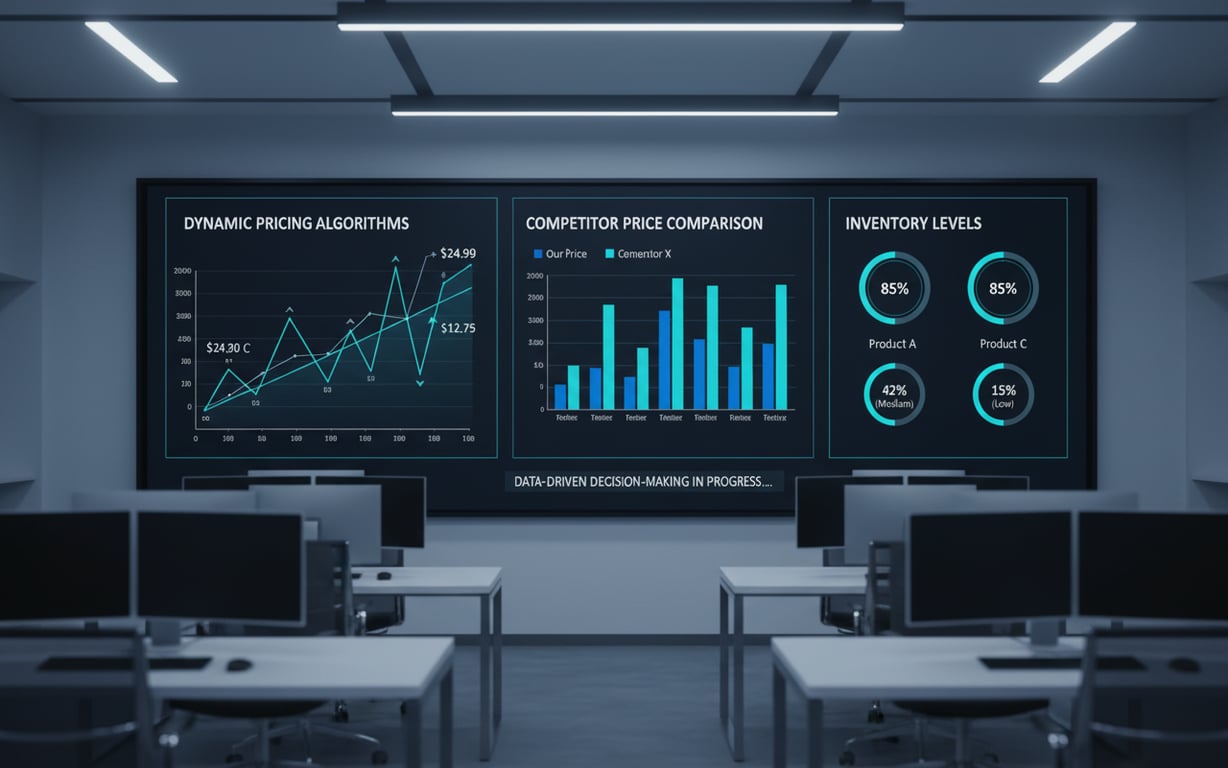
Price planning in retail is the structured, forward-looking process of determining how products will be priced across an entire assortment, over a defined time horizon, and in alignment with broader business objectives. It integrates costs, competitive positioning, customer psychology, seasonal demand cycles, promotional calendars, and margin targets into a coherent system - transforming pricing from a reactive task into a proactive competitive advantage.
What is price planning in retail
Price planning is so much more than slapping a number on a tag. It goes far beyond the act of simply attaching a price to a product. While setting a price is a single decision, price planning is a system — one that accounts for costs, competitive positioning, customer psychology, seasonal demand cycles, promotional calendars, and margin targets all at once.
What are the core components of a retail pricing definition?
At its core, the pricing definition in a retail context encompasses three interconnected layers:
Strategic intent: What role does pricing play in your brand positioning? Are you a value leader, a premium destination, or a mid-market competitor?
Operational structure: What rules, guardrails, and approval workflows govern how prices are set and changed?
Analytical feedback: How does performance data flow back into future pricing decisions?
The pricing fundamentals also include understanding the difference between initial markup (the margin built in at the time of purchase) and maintained markup (the margin actually realized after markdowns and promotions). These two figures rarely match, and the gap between them is one of the most revealing indicators of pricing discipline in any retail operation.
A comprehensive system built on solid pricing basics integrates category-level margin goals, vendor cost negotiations, competitive intelligence, and customer demand signals into a framework that guides every decision — from everyday shelf prices to clearance markdowns. Get the pricing concepts right, and pricing stops being a chore and becomes a genuine competitive edge.
Why pricing approach matters for retail success
The way a retailer approaches pricing decisions has a direct and outsized impact on profitability. Unlike most cost-reduction initiatives, which yield incremental gains, a well-designed pricing approach can improve gross margin by several percentage points without requiring changes to the product assortment or store operations. McKinsey research has consistently shown that a 1% improvement in price realization translates to an 8–11% improvement in operating profit for the average retailer — a leverage ratio that no other operational lever can match.
What happens with poor price management versus optimized pricing?
Poor pricing creates compounding problems. Prices set too low erode margin and train customers to expect discounts. Prices set too high suppress conversion and drive shoppers to competitors. Inconsistent pricing across channels damages brand trust and creates arbitrage opportunities that undermine full-price selling. Retailers who lack a structured approach to how pricing works often find themselves in a reactive cycle - discounting to clear inventory that was mispriced from the start.
Optimized retail pricing decisions, on the other hand, create a virtuous cycle. When prices are set with precision, inventory turns at healthier rates, markdowns are planned rather than emergency measures, and customer expectations are managed proactively. For retailers operating on thin margins — as most do — the difference between a reactive and a strategic approach is often the difference between profitability and loss.
Core pricing strategy frameworks for retailers
Retailers draw on several foundational frameworks when developing a pricing strategy, and the most effective operations typically combine elements from more than one. Understanding these frameworks is essential before building any pricing structure or process.
Cost-based pricing: Anchors decisions to the cost of goods and a target margin.
Value-based pricing: Anchors decisions to what customers are willing to pay based on perceived benefit.
Competitive pricing: Anchors decisions to what the market — specifically, key competitors — is charging for comparable products.
Psychological pricing: Uses price points such as charm pricing at $9.99 or $19.95 to influence customer perception.
Portfolio pricing: Treats the entire assortment as a system where some items are priced for traffic generation (known as key value items or KVIs) and others are priced for margin contribution.
A well-designed pricing framework and pricing process will specify which approach applies to which product category, ensuring that decisions are consistent and intentional rather than ad hoc. Effective pricing and promotion optimization requires selecting the right framework for each category and applying it with discipline across the full assortment.
Essential components of a retail pricing plan
A comprehensive pricing plan is more than a spreadsheet of prices. It is a living document and operational system that governs how prices are set, monitored, adjusted, and communicated. The following components are non-negotiable in any effective planning in retail exercise focused on pricing.
Margin targets by category: Every category should have a defined gross margin goal that reflects its strategic role. High-traffic, price-sensitive categories may carry lower margin targets, while specialty or exclusive categories should carry higher ones. These targets provide the guardrails within which individual pricing rules operate.
Pricing rules and logic: Rules define how prices are calculated — for example, "all items in Category A must carry a minimum 42% gross margin" or "no item may be priced more than 10% above the lowest competitor price for that SKU." These encode strategy into repeatable, scalable decisions.
Promotional calendar integration: The plan must align with the promotional calendar so that planned discounts are factored into margin forecasts from the outset, not treated as surprises after the fact.
Markdown and clearance policies: A clear policy for when and how to mark down slow-moving inventory prevents both premature discounting (which erodes margin unnecessarily) and late discounting (which results in excess inventory and write-offs).
Competitive monitoring cadence: Specify how frequently competitor prices are reviewed and what triggers a price response. This prevents both over-reaction to short-term competitive moves and under-reaction to sustained market shifts.
Channel and location rules: For multi-channel or multi-location retailers, the plan must address whether prices are standardized or differentiated, and under what conditions local or channel-specific adjustments are permitted.
Together, these components create a system that is both strategically coherent and operationally executable. Aligning your price planning with your broader assortment planning and category management strategy ensures that margin goals and product mix decisions reinforce each other.
Cost based pricing - Building from your foundation
What is cost-based pricing?
Cost based pricing is the most straightforward of the retail pricing methods and the logical starting point for any pricing plan. The basic formula is simple: take the cost of goods sold (COGS), add a target price markup percentage, and arrive at the retail price. For example, if an item costs $20 and the target markup is 50% of the retail price, the selling price is $40.
Advantages: Ensures every item sold contributes positively to gross margin, is easy to implement at scale, and provides a defensible floor below which prices should not fall without explicit justification. Particularly well-suited to commodity categories where differentiation is low and cost efficiency is the primary competitive lever.
Limitations: Ignores what customers are actually willing to pay, which means it can leave money on the table for high-demand or differentiated products. Also fails to account for competitive dynamics — a price that covers costs and hits your margin target may still be uncompetitive in the market.
For these reasons, cost-based merchandise pricing works best as a floor-setting mechanism rather than a complete strategy. Most sophisticated retailers use it as the baseline and then layer value-based and competitive adjustments on top.
Value based pricing - Aligning with customer perception
What is value-based pricing?
Value based pricing shifts the anchor point from internal costs to external customer perception. The central question is not "what does this cost us?" but "what is this worth to the customer?" When a retailer can answer that question accurately, it unlocks the ability to price products at their true market value — which is often higher than a cost-plus calculation would suggest.
Determining perceived value requires research. Customer surveys, conjoint analysis, price sensitivity testing, and analysis of historical sales data at different price points all contribute to a clearer picture of willingness to pay. Here's a useful price point example: a specialty outdoor retailer might find that customers perceive a particular hiking boot as worth $180 even though a cost-plus approach would price it at $140. Pricing at $175 captures more value while remaining within the customer's acceptable range.
This approach is most powerful in categories where brand equity, exclusivity, or unique product attributes create genuine differentiation. It is also highly effective for private-label products, where the retailer controls both the cost structure and the brand narrative. The key to figuring out how to price products this way is segmenting the assortment by perceived value tier and applying different pricing logic to each tier, rather than applying a uniform markup across all products.
Competitive pricing strategies in retail
No price strategy retail approach exists in a vacuum. Customers compare prices -increasingly in real time, using smartphones on the shop floor — and competitors adjust their prices continuously. A structured approach to retail competitive pricing ensures that your retail store pricing remains relevant without triggering a race to the bottom.
The first step is identifying your true competitive set. Not every competitor matters equally for every category. A grocery retailer may need to match Walmart on staple items but can price independently on specialty or organic products where the competitive overlap is lower. Defining which competitors to track, for which categories, and at what frequency is a foundational decision.
Best practices for maintaining competitive positioning while protecting margins include:
Use KVIs as price-match anchors while maintaining margin on the broader assortment.
Set price index targets (e.g., "we will be within 3% of the market leader on KVIs") rather than matching every price change.
Treat competitive data as one input among several rather than the sole driver of pricing decisions.
Reactive price-matching without margin guardrails is one of the fastest ways to destroy retail profitability.
How to price products - A step-by-step pricing guide
Setting retail prices systematically requires working through a defined sequence of decisions. This pricing guide applies to new product introductions as well as periodic price reviews for existing items — think of it as pricing 101 for any retailer who wants to move from gut feel to discipline. Consider it your pricing overview for everyday price setting.
Establish the cost baseline. Confirm the landed cost of the product, including freight, duties, and any handling fees. This is your absolute floor.
Apply category margin targets. Using your pricing plan's margin guidelines for the relevant category, calculate the minimum acceptable retail price. For a product costing $25 with a 40% gross margin target, the minimum price is $41.67.
Assess competitive positioning. Check current market prices for comparable products. Determine whether you need to be at, below, or above the market based on your competitive strategy for that category.
Evaluate perceived value. Consider whether the product's features, brand, or exclusivity justify a premium above the competitive baseline. If so, test a higher price point.
Apply psychological pricing adjustments. Round to a price point that aligns with customer expectations — $49.99 rather than $50.12, for example.
Model the promotional impact. Before finalizing, model what happens to margin if the item is included in a planned promotion. Ensure the promotional price still meets minimum margin thresholds.
Set review triggers. Define the conditions — cost changes, competitive moves, sell-through rates — that will prompt a price review. Pricing is not a set-and-forget decision.
Accurate demand signals at each step are easier to interpret when supported by robust retail demand forecasting methods that anticipate how customers will respond to different price levels.
Dynamic pricing - Adapting to market conditions
What is dynamic pricing in retail?
Dynamic pricing is the practice of adjusting prices in response to real-time or near-real-time changes in demand, competition, inventory levels, or other market signals. In retail environments, it represents the most sophisticated end of the price planning spectrum — and increasingly, the most necessary one for retailers competing with large e-commerce platforms.
The mechanics of demand pricing rely on three inputs: demand signals (sales velocity, search trends, cart abandonment rates), competitive signals (competitor price changes detected through web scraping or price intelligence tools), and inventory signals (stock levels relative to sales rate and remaining selling season). Algorithms process these inputs and recommend or automatically execute price changes within predefined guardrails. Strong price forecasting capabilities make these recommendations far more accurate.
Implementing this successfully requires both technology and governance. On the technology side, retailers need a price intelligence platform capable of ingesting competitive data, a pricing engine that can apply rules and generate recommendations, and integration with the point-of-sale and e-commerce systems that execute the changes. On the governance side, retailers need clear rules about how large a price change can be made automatically versus requiring human approval. For a deeper exploration, the complete guide to dynamic pricing in retail covers the full range of optimization and competitive pricing strategies in detail.
Retail price optimization through dynamic pricing has been shown to improve gross margin by 2–5% in categories where demand elasticity is well understood and competitive data is available in near real time.
Promotional pricing tactics and seasonal strategies
Promotional pricing is one of the most powerful tools in a retailer's arsenal — and one of the most frequently misused. When planned strategically, promotions drive traffic, accelerate inventory turns, and reward loyal customers. When used reactively or excessively, they train customers to wait for discounts, erode brand equity, and compress margins in ways that are difficult to reverse.
Effective promotions begin with the promotional calendar, which should be built at the start of each season or fiscal year. Each planned event should have a defined objective (traffic driving, margin contribution, inventory clearance, or customer acquisition), a target discount depth, and a projected margin impact that has been approved against category targets.
Seasonal pricing strategies require particular discipline. End-of-season clearance is inevitable in most retail categories, but the timing and depth of markdowns should be governed by a markdown optimization policy rather than gut instinct. A common best practice is the "tiered markdown" approach: a modest initial markdown (15–20%) taken early enough to stimulate sell-through, followed by deeper markdowns only if velocity targets are not met. Discount pricing should always be evaluated against the full-price sell-through rate — if more than 30–40% of a category's volume is sold on promotion, the everyday price may be set too high.
Price management across channels and locations
For retailers operating across multiple channels — physical stores, e-commerce, marketplace listings, and mobile apps — and multiple geographic locations, price management becomes significantly more complex. The central tension is between consistency (which builds customer trust and simplifies operations) and differentiation (which allows prices to reflect local competitive conditions, cost-to-serve differences, and channel-specific customer expectations).
Most retailers adopt a hybrid approach. Core pricing rules and margin targets are standardized across all channels and locations, but a defined set of adjustment factors allows for local or channel-specific variation. For example, an e-commerce channel may carry slightly lower prices to reflect the absence of in-store service costs, while a store in a high-rent urban market may carry slightly higher prices to reflect elevated operating costs.
The key to managing this complexity is a centralized pricing engine that enforces the core rules while allowing parameterized exceptions. Without centralized retail price optimization tools, multi-channel pricing quickly becomes inconsistent and unmanageable — creating customer confusion, compliance risks, and margin leakage. Data-driven approaches are explored in depth in this look at how data analytics and business intelligence transform modern retailers.
Common challenges in retail price planning
Even well-designed strategies encounter predictable obstacles in implementation. Understanding these challenges in advance allows retailers to build mitigation into their price planning from the outset, sharpening their overall pricing approach and the quality of their retail pricing decisions.
Data quality: Pricing decisions are only as good as the cost, competitive, and demand data that inform them. Retailers with fragmented systems — where cost data lives in one platform, sales data in another, and competitive data in a third — struggle to make timely, accurate pricing decisions.
Organizational alignment: Pricing decisions touch merchandising, marketing, finance, and store operations simultaneously. Without clear ownership and cross-functional governance, decisions become slow, inconsistent, or politically driven rather than analytically grounded.
Change management: Shifting from intuition-based to data-driven pricing requires cultural change as well as system change. Buyers and category managers who have historically set prices based on experience may resist algorithmic recommendations, even when the data supports them.

Measuring and optimizing your pricing strategy
A pricing strategy that is not measured is not managed. Retailers should track a core set of performance metrics on a regular cadence — weekly for fast-moving categories, monthly for slower-turning ones — and use that data to drive continuous improvement in price management and ongoing retail price optimization.
Gross margin percentage by category: Actual versus target.
Price realization rate: The percentage of sales made at full price versus promotional price.
Markdown rate: The percentage of inventory sold below initial retail.
Competitive price index: Your prices relative to key competitors on tracked SKUs.
Promotional ROI: The incremental sales and margin generated by each promotion versus the baseline.
Optimization is iterative. Each pricing cycle should include a structured review of what worked, what did not, and what adjustments are warranted. Retailers who build this rhythm into their operations consistently outperform those who don't - better data leads to better decisions, which leads to better outcomes, which generates better data.
Frequently Asked Questions
What is the difference between price planning and price setting? Price setting is the act of assigning a specific price to a specific product at a specific moment. Price planning is the broader, ongoing system that governs how those decisions are made — including the frameworks, rules, margin targets, competitive guidelines, and review processes that ensure pricing decisions are consistent, strategic, and aligned with business objectives. Price setting is a task; price planning is a discipline.
How often should a retailer review and update prices? It depends on the category and competitive environment. Fast-moving consumer goods in highly competitive categories (electronics, grocery staples) may require weekly or even daily reviews. Slower-moving specialty categories may only need monthly or seasonal reviews. The key is to define review triggers — cost changes, competitive moves, sell-through deviations — so that prices are updated when conditions warrant it, not on an arbitrary schedule.
What is a key value item (KVI) and why does it matter for pricing? A key value item is a product that customers use as a price reference point when evaluating a retailer's overall value proposition. KVIs are typically high-frequency purchase items or well-known branded products that customers price-check regularly. Because customers form their perception of a retailer's pricing based heavily on KVI prices, it is critical to be competitively priced on these items — even if it means accepting lower margins — while maintaining stronger margins on the broader assortment.
How does dynamic pricing differ from promotional pricing? Promotional pricing involves planned, time-limited price reductions designed to drive specific business outcomes (traffic, inventory clearance, customer acquisition). Dynamic pricing involves algorithmic, continuous price adjustments in response to real-time market signals such as demand changes, competitor price moves, or inventory levels. Promotional pricing is calendar-driven and manually planned; dynamic pricing is data-driven and often automated within predefined guardrails.
Can small retailers implement price planning effectively without sophisticated technology? Yes. While enterprise pricing software accelerates and scales the process, the foundational elements — margin targets by category, pricing rules, competitive monitoring, and markdown policies — can be implemented using spreadsheets and manual competitive checks. The discipline of having a documented plan and reviewing it regularly delivers significant value even without automation.
What is the relationship between pricing and inventory management? They are deeply interdependent. Prices that are set too high slow inventory turns and increase the risk of excess stock requiring markdown. Prices set too low accelerate turns but may create stockouts and lost margin. Effective price planning incorporates sell-through rate targets and inventory position data so that pricing decisions actively support inventory health.
How should retailers handle price increases without losing customers? Communicating value is the most effective strategy. When raising prices, retailers should ensure that the product's quality, service, or convenience benefits are clearly communicated. Phasing increases gradually, bundling value-added services, and timing increases to coincide with product improvements all reduce customer resistance. Transparency — particularly for loyal customers — builds trust and reduces the likelihood of switching behavior.
What is price elasticity and how does it affect retail pricing decisions? Price elasticity measures how sensitive customer demand is to price changes. A product with high elasticity sees significant demand changes in response to small price movements; a product with low elasticity sees little demand change even with substantial price moves. Understanding elasticity by product and category allows retailers to raise prices on inelastic items to capture margin and be more cautious with price increases on elastic items where volume loss would outweigh the margin gain.
How do retailers manage pricing for private-label versus national brand products? National brand prices are heavily influenced by competitive benchmarks and manufacturer suggested retail prices (MSRPs). Private-label pricing offers much greater flexibility because the retailer controls both the cost structure and the brand narrative. Most retailers price private-label products at a meaningful discount to the national brand equivalent (typically 15–25%) to drive trial and switching, while maintaining higher gross margins due to lower cost of goods.
What are the most important first steps for a retailer starting to build a formal price planning process? The most impactful first steps are: (1) document your current pricing rules and margin targets by category — even if they exist only in people's heads; (2) establish a competitive monitoring process for your most important KVIs; (3) build a promotional calendar that includes projected margin impact for each planned event; and (4) define a regular pricing review cadence with clear ownership.


Comments