
Store Clustering for Assortment and Replenishment: Which Models to Use

Store clustering for assortment and replenishment groups stores that share similar demand patterns, such as category mix, size, or customer profile, so merchandising and supply chain teams can plan at the group level instead of building one chain-wide plan or hundreds of store-specific ones. The right clustering model, ranging from manual volume grading to machine-learning-driven segmentation, depends on fleet size, data maturity, and how differently stores actually behave, and the clusters only pay off when assortment buys and replenishment rules are built to follow them.
Table of Contents
A single chain-wide assortment plan rarely fits any one store well, yet planning hundreds of locations individually is not realistic for most merchandising teams. Store managers and operations leaders are left deciding which grouping method, how many groups, and how much automation actually make sense for their business. This article covers the clustering models available, the data that feeds them, and how defined clusters change both what gets bought and how it gets replenished.
What is store clustering for assortment and replenishment?
Store clustering for assortment and replenishment is the practice of grouping stores that behave similarly, in sales pattern, size, climate, or customer profile, so planners can build one assortment and replenishment strategy per group instead of one per store or one for the entire chain. Each store in a cluster receives a similar product mix, depth, and reorder logic, which feels localized to its shoppers without requiring a fully custom plan for every address.
Within the planning hierarchy, clustering sits between two extremes that both break down at scale: a single assortment for every door, which ignores real demand differences, and a unique plan per store, which is impossible to build and maintain once a chain passes a modest number of locations. Clustering groups stores with correlated demand, then lets buying, allocation, and reorder decisions happen at that intermediate, manageable level.
Why do retailers use store clustering?
Retailers move from a single chain-wide plan to clustered store groups because a chain average rarely describes any individual store well, while planning every location separately is too slow and labor-intensive to sustain. Clustering lets a team work with a handful of representative groups rather than one plan or hundreds.
Planning efficiency: Building five to ten cluster-level plans instead of one for every store frees planners to focus on strategic assortment and buying decisions rather than door-by-door spreadsheets.
Sharper forecasting: Grouping comparable stores smooths out random noise in the data while still capturing a cluster's real demand trend, which a single chain-wide average cannot do.
Localized assortments: Clusters allow a cold-weather group of stores to receive outerwear earlier and in greater depth than a warm-weather group, without planning each store individually.
Tighter inventory allocation: Linking cluster-specific assortment plans to allocation reduces the need to ship excess stock to the wrong locations and then transfer it mid-season.
Better customer experience: Shoppers find a product mix that matches local expectations, which reinforces loyalty to the store as relevant to their market.
Retail clustering across store formats and channels
Retail clustering applies differently depending on format and category because the attributes that separate stores change by business model. A convenience chain may cluster primarily on category mix share, since one group of stores can run a food-service-heavy profile while another leans on beer and packaged beverage, with the gap between the two far wider than any chain average suggests. An apparel retailer more often clusters on customer demographics and demand pattern, separating an urban trend-forward group from a suburban family-oriented one, while still tracking store size and capacity as a second dimension.
Climate-driven categories such as outerwear usually need their own clustering lens, since the week demand actually opens can shift by several weeks between warm and cold markets, and a single flow date serves neither well. Retailers running both direct-to-consumer stores and wholesale accounts also treat the two as separate clustering problems, because wholesale sell-in data often reflects a buyer's order pattern rather than true consumer demand at the shelf.
Which factors determine store cluster segmentation?
Store cluster segmentation is determined by the attributes and sales data that reveal how stores actually differ, not by assumptions about geography or size alone. Effective clustering combines several data families drawn mostly from a retailer's own point-of-sale and operational systems.
Category mix share: Each store's sales by category expressed as a percentage of its own total, which reveals assortment differences a chain average hides.
Rate of sale and capacity: Units sold per store per week relative to selling space, shelf count, or option count, which shows how hard a category works in a given footprint.
Customer demand and demographics: Local shopper preferences, often measured through a demand index that compares a store's sales for a product class against a chain baseline.
Price sensitivity and basket composition: The share of units sold on promotion, average selling price versus the chain, and items per basket, which separate value-driven stores from full-price ones.
Climate, geography, and store format: Weather patterns, regional tastes, and physical size or layout, which affect seasonal timing and depth even when sales volume looks similar.
A demand index is one of the more practical formulas for turning raw sales into a comparable segmentation input: Demand Index = (store's sales for a category ÷ chain baseline sales for that category) x 100. A store scoring well above 100 is over-indexed on that category relative to the fleet, a signal worth building into its cluster assignment. Retailers refining these inputs often lean on structured demand analysis similar to what is described in forecast accuracy measurement practices, since the same historical sales patterns that improve a forecast also sharpen a cluster.
Store clustering models and techniques explained
Store clustering models range from simple manual grading to fully data-driven machine learning, and the right choice depends on fleet size, data quality, and how much nuance the business needs. Three approaches cover most of what retailers actually use.
Manual, or top-down, clustering groups stores using known attributes such as size, format, or region, often built in a spreadsheet by plotting sales on a scatter chart and labeling the resulting tiers. It is fast to set up but typically considers only one or two factors at a time, so it risks lumping together stores that look similar on paper but behave very differently at the register. Data-driven, or bottom-up, clustering instead lets statistical techniques such as k-means or correlation analysis find natural groupings across many variables at once, including category mix, rate of sale, and price sensitivity. Hybrid clustering, increasingly common among growing retailers, combines a demand-pattern grouping with a volume tier and a strategic role, so the cluster decides the assortment while the tier decides the depth.
Model | Data required | Best suited for | Main limitation |
Manual / top-down grading | Sales volume, store size, region | Small fleets, early-stage clustering | Captures only one or two factors at a time |
Data-driven / bottom-up (k-means, correlation) | Multi-category sales, demographics, price data | Mid-to-large fleets with clean POS history | Requires analytical effort and clean data |
Hybrid clustering | Demand pattern plus volume tier plus strategic role | Growing retailers balancing nuance with manageability | Adds a layer of complexity to maintain |
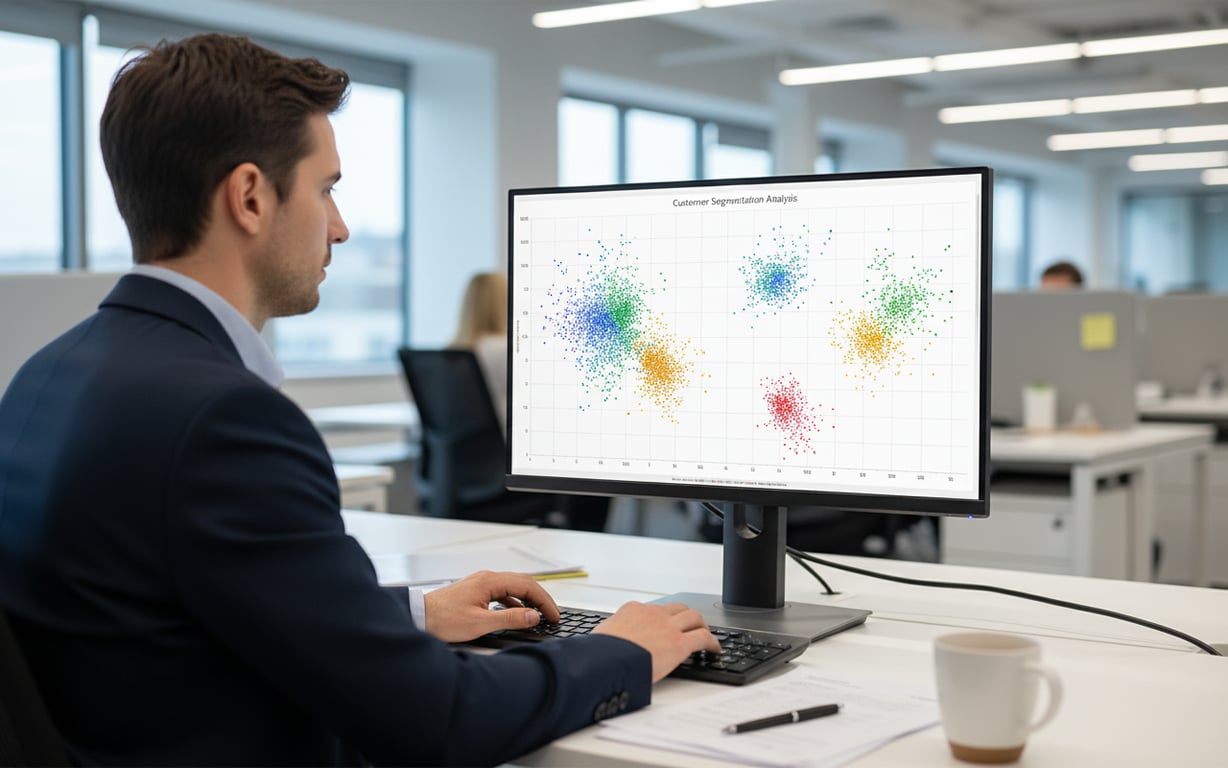
When comparing two candidate clusters, a useful check is whether next season's plan would genuinely differ between them in anything beyond depth. If the only difference is how much of the same assortment each receives, that is store grading rather than true clustering, a distinction worth keeping clear as the model matures.
How does store clustering improve assortment planning?
Store clustering improves assortment planning by letting each group of stores carry a width, depth, and seasonal flow that fits its own demand rather than a chain-wide average. A fashion-forward urban cluster might carry a narrower size range but a wider trend assortment, while a suburban cluster carries a fuller size curve with fewer trend-only styles.
Seasonal and climate-driven categories benefit the most. Take outerwear: a cold-weather cluster of stores should receive coats earlier and in greater depth, while a warm-weather cluster receives lighter apparel and gets winter stock later or not at all, avoiding both lost full-price sales in cold markets and markdown-bound excess in warm ones. Clusters also support finer size-curve planning, since the share of units sold by size is a cluster-level property that should be fitted only on periods when a store actually held a complete size run, not on sales left over after popular sizes have already sold through. Retailers formalizing this process often pair cluster definitions with dedicated space and assortment planning tools that connect cluster-level rules directly to planograms and buy quantities, and teams building the underlying framework from scratch can draw on a broader assortment planning guide covering category management fundamentals alongside clustering.
How is replenishment affected by store clustering?
Defining store clusters changes replenishment by moving reorder points, safety stock, and allocation rules away from a single chain-wide setting toward cluster-specific logic that matches each group's actual sales velocity. A high-volume cluster can run tighter safety stock relative to its turns, while a lower-volume cluster needs a different buffer to avoid stockouts without overstocking slow sellers.
Allocation logic shifts as well. Initial shipments follow cluster-level rules rather than a blanket chain split, and in-season transfers should happen within a cluster first, since a transfer between two similar stores is far more likely to sell through than one routed to a store with a different demand profile. This matters because a cluster-level assortment plan only delivers results if replenishment and supply execution actually follow it store by store; a localized plan that still ships against standardized reorder rules ends up localized on paper but standardized on the shelf. Retailers closing that gap typically invest in inventory and replenishment systems built to execute cluster-specific rules automatically, and teams refining reorder points and buffer stock by group can apply the broader calculation methods in a dedicated guide to replenishment optimization.
Choosing the right assortment planning software
Assortment planning software should be chosen for its ability to turn cluster definitions into buy plans without forcing planners back into manual spreadsheets. The first priority is multidimensional analysis: a platform that can evaluate sales by category, store size, demographics, and climate together, rather than one variable at a time, produces clusters that hold up better than a simple scatter-chart exercise.
Automated, dynamic re-clustering: The ability to recalculate clusters each planning cycle or season as sales patterns, store openings, and closures change.
Category-level granularity: Support for clustering down to department or class level, not just total store sales.
Scenario and test capability: Built-in testing, similar to the cluster-based A/B testing offered in platforms like LEAFIO AI, to validate an assortment change before rolling it out fleet-wide.
Integration with planograms and buying: A direct link between cluster assignment and the assortment width, depth, and size curve a planner builds.
Visualization and exception flagging: Dashboards that surface outlier stores drifting away from their assigned cluster before the next planning cycle.

Platforms built specifically for merchandise planning, such as Toolio or LEAFIO AI, show how automated clustering has moved from a manual, labor-intensive exercise to one that can be recalculated in minutes rather than weeks, freeing planners to interpret results instead of building them by hand.
Evaluating retail replenishment software options
Retail replenishment software is effective when it can execute cluster-specific reorder logic in real time rather than applying one fixed rule across the whole chain. The core requirement is that reorder points, safety stock, and allocation quantities update automatically as a store's cluster assignment or sales pattern shifts, without a planner manually adjusting every location.
Strong platforms also coordinate replenishment with the assortment plan so that a cluster's localized buy actually reaches the shelf it was designed for. Research into localized retail execution consistently finds that programs succeed or fail on supply chain coordination rather than on the sophistication of the clustering analysis itself. Look for real-time inventory visibility across clusters, automated transfer logic that prioritizes moving stock within a cluster before routing it elsewhere, and exception alerts when a store's actual sell-through diverges from its cluster's expected pattern. These capabilities close the gap between a well-built cluster model and a shelf that genuinely reflects it.
Frequently asked questions
How many stores does a chain need before clustering makes sense? Most practitioners suggest clustering becomes worthwhile once a chain passes beyond 10 stores or starts showing noticeably different sales or geographic patterns between locations; below that, individual store plans are still manageable.
How often should clusters be re-evaluated? Clusters should be rebuilt at least once per planning cycle, and ideally ahead of each major season, since store performance and customer behavior shift over time and stale clusters produce outdated assortment and replenishment decisions.
What is a merge test and why does it matter? A merge test asks whether two candidate clusters would actually receive different plans next season; if the only difference is depth rather than assortment content, the two should be merged, since that distinction is store grading rather than clustering.
How many clusters should a retailer start with? Many growing retailers settle on roughly two to ten clusters at first, balancing enough nuance to localize decisions against having too many groups for a small team to maintain and audit.
Can clustering work without machine learning? Yes. Smaller chains can cluster manually using sales scatter charts or correlation analysis in a spreadsheet, though this approach is more labor-intensive and considers fewer variables than an algorithmic method.
How does clustering reduce markdown costs? By matching assortment depth and seasonal flow to each cluster's real demand, clustering avoids shipping excess inventory, such as winter coats to a warm-weather cluster, that would otherwise end up marked down.
What is the difference between clustering and store grading? Store grading sorts stores into volume tiers that set depth and priority for new arrivals, while clustering groups stores by demand pattern to determine what assortment content each group carries.
How does clustering affect planogram execution? Each cluster typically receives its own planogram variant reflecting its category mix and size curve, so floor space allocation matches what that group of stores actually sells rather than a single chain-wide layout.
What role does human oversight play as clusters evolve? Clustering outputs are a starting point, not a final answer; planners still need to review outlier stores, validate that cluster names reflect real behavior, and confirm cluster-based plans are hitting targets.
How do overstock signals from clusters trigger clearance actions? When a store consistently sells below its cluster's expected rate for a category, that gap flags excess inventory early, allowing a targeted clearance or transfer to a better-fit cluster before markdowns deepen.
Store clustering turns an unmanageable number of store-level decisions into a handful of plans a merchandising team can actually execute, but the model chosen matters less than the discipline of validating, updating, and connecting those clusters to real assortment and replenishment actions. Retailers that treat clustering as a living process, revisited each season and tied directly to buying and reorder logic, consistently see sharper forecasts, fewer markdowns, and stores that feel tuned to their own customers.


Comments